
By Foster Akpore
Ughelli, Delta State – October 1, 2025
As Nigeria marked her 65th Independence Anniversary, Abraham’s Place, Ughelli became the stage for a civic reflection on democracy and human rights. The Citizens Rights Concern Enhancement Initiative (CRCEI), also known as the Human Rights Protection Congress, convened its 3rd National Dialogue with the theme: “Democracy, Youth Development and Human Rights Advancement: Securing Nigeria’s Next 25 Years.” The gathering drew human rights advocates, civil society leaders, youth representatives, and policymakers to assess Nigeria’s democratic journey and chart pathways for the future.
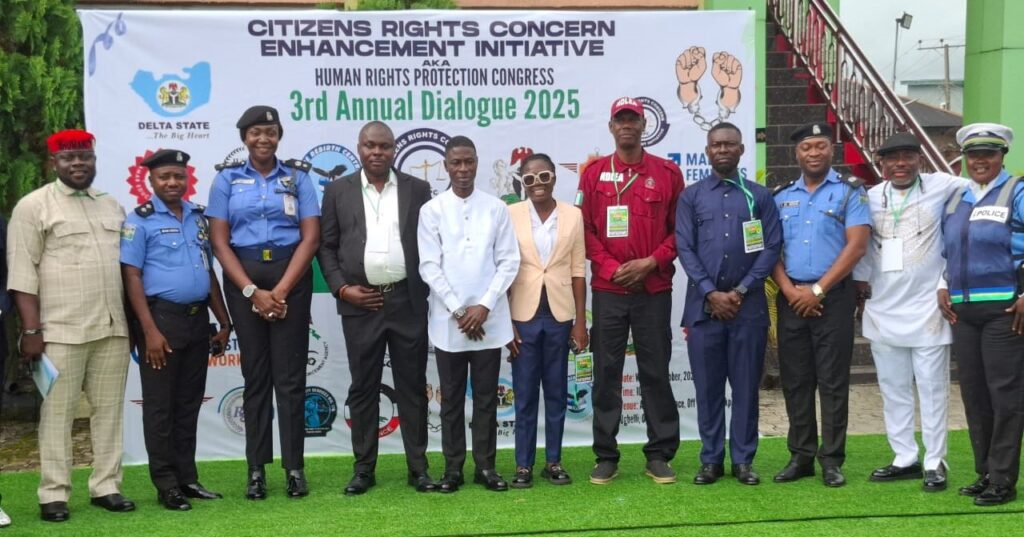
In his welcome address, Dcn. Comr. Monday Enudi, National Coordinator of CRCEI, situated the dialogue within the organisation’s three-year record of advocacy. He outlined interventions ranging from free legal aid for indigent inmates and litigation on road safety, to community health, education projects, and security collaborations. “CRCEI was born out of a conviction that the dignity of every citizen must be respected, that democracy must not just survive but thrive, and that human rights must be protected as the bedrock of a just society,” Enudi said.
Echoing this vision, Amb. Pastor Edewor Egedegbe, Chairman of the CRCEI Board of Trustees, warned that democracy without the active vigilance of citizens was a democracy at risk. He noted that gender-based violence remained one of the greatest threats to peace and justice, urging Nigerian men to stand beside women in dismantling harmful traditions. “A democracy that overlooks the pain of women and girls is incomplete. A nation that silences half of its population cannot achieve true progress,” he declared.
The intellectual highlight came from Ikimi Oghenejakpor (Esq.), who in a keynote lecture questioned Nigeria’s model of governance. He argued that the country had slipped into “government of the government, by the government, and for the government,” instead of the classical vision of governance for the people.
“Look at Saudi Arabia. They are preserving their oil wealth for the next 200 years, for generations yet unborn. I am not sure we are doing the same here. Sometimes it feels as if strangers came to occupy this place called Nigeria,” he said.
He called for the establishment of special electoral courts to expedite election petitions, insisting that regular courts were overstretched and that justice delayed undermined democracy. “We must conclude election petitions before swearing-in. Electoral courts will safeguard our democracy for the next 25 years,” he urged.
Beyond judicial reform, Oghenejakpor pressed for renewed investment in civic and moral education, warning that compromised examinations and corruption in schools were producing weak graduates unfit to lead or compete globally. He also advocated reforms in the Human Rights Commission, stressing that punishment for abuses must be certain and consistent if violations were to be curbed.
“Until we reform our education, strengthen our judiciary, and stop gambling with our youths, Nigeria cannot progress. We have over 100 million young people in this country. If they are organized and enlightened, they can reshape leadership through the ballot,” he declared.
He commended the role of civil society, security agencies, and professionals in sustaining human rights advocacy, calling for synergy and collective action. He closed on a simple but weighty note: “Let us embrace peace. The peace I am talking about is spelled P-E-A-C-E, not piece. Let us love our neighbors as ourselves.”
The dialogue also featured goodwill remarks from Comrade Okoh O. Ezekiel, PhD, Chairman of the Occasion and Executive Assistant to the Governor of Delta State, Rt. Hon. (Elder) Sheriff Francis Oborevwori, on Education. Responding to the thought-provoking observation by CSP Temi Agbede-Zuokumor (Esq) on moral decadence among secondary school students—often with tacit support from parents and school authorities—he addressed the students directly, grounding his message in personal experience.
“When I was in primary school, I once came second in class. I walked home crying, sat by the roadside, and someone had to call my mother to come and see me. That was how much I valued being first,” he recalled.
Drawing from this story, he stressed that discipline begins in the home. “No matter what teachers do, it is the upbringing and values from home that shape us most. Today, as we reflect on building a Nigeria we can be proud of, let us remember that responsibility does not rest only on government officials, commissioners, or ministries. It starts with us—parents, guardians, students, and every member of society. If each of us embraces discipline, diligence, and integrity, then truly, we can build a Nigeria that we will all be proud of.”
The programme then transitioned into a panel session moderated by Ayo Okotie Nefertiti, who steered conversations on democracy, youth, and human rights.
Discussions opened with reflections on accountability. Barr. Casley Omo-Irabor remarked: “We don’t truly have democracy, only civilian regimes. If democracy is to be defined properly, we must stop blaming only government officials. Citizens too must re-orient themselves. There must be checkpoints and accountability if society is to advance.”
On youth development, Amb. Mrs. Stella Odika responded: “When we talk about Nigeria at 65, I liken it to a 65-year-old man who has a child late in life. That man will do everything possible to equip that child, so that when he is gone, the child can carry on his legacy. For Nigeria, our ‘children’ are the youth. Government must invest in quality education, vocational training, and entrepreneurship. Through my own initiative, we mentor and instill values in young people, because without values, even the best systems will fail.”
Comrade Kelvin Ejumudo pressed for curriculum reform: “The Igbo apprenticeship model produces entrepreneurs. Our school system produces graduates who cannot even find their feet. We must redesign our curriculum to teach problem-solving, entrepreneurship, and conflict management. And we must regulate social media to stop misleading young people into vices and distractions.”
From the NDLEA perspective, Officer Paul Okoh emphasized parental and societal responsibility in addressing drug abuse: “No child is born bad. They reflect the society they grow up in. If we fix our homes and communities, we will fix the youth. Substance abuse is not only a law enforcement issue; it is a societal failure.”
On technology and security, CSP Temi Agbede-Zuokumor observed: “Technology is key. If we install CCTV in public spaces, crime will reduce drastically. Many crimes go unresolved because we lack surveillance and enforcement. If we embrace technology, democracy will thrive because citizens will feel safe, and their rights will be better protected.”
The panel closed with a call to action: “If each of us brings one more person along on this journey, Nigeria at 90 will look back and say we built a better nation,” the moderator concluded.
The event concluded with a Distinguished Service Awards presentation by CRCEI, recognising outstanding contributions to justice, civic responsibility, and public safety. Honorees included:
Supol Robinson Julius, Delta Police Command, for strategic crime-fighting initiatives.
CSP Temi Agbede-Zuokumor Esq., DPO Ugborikoko, for bringing innovation and patriotism into female policing.
Hon. Justice A. V. Akpovi, High Court Judge, Warri, for uprightness in the dispensation of justice.
ACGN Tunde John, Esq., NDLEA Zonal Commander, Zone 9 Ibadan, for outstanding performance as a crack drug enforcement officer.
Tantita Security Services Nigeria Limited, for effective corporate social responsibility in the Niger Delta.
W/Sergeant Nwokolo Mercy, Warri Area Command, for her commitment to traffic safety.
The 3rd CRCEI Dialogue ended with optimism and urgency. As participants dispersed, one message lingered: Nigeria’s next 25 years will not be determined by government alone but by the collective choices of citizens, institutions, and leaders committed to democracy and justice.