
By Foster Akpore, Warri
The Male Feminist Network (MFN), South-South Region, was formally launched on Friday, October 10, 2025, at the Nigeria Union of Journalists (NUJ) Press Centre in Warri, Delta State, with a strong call for men to take an active role in promoting gender equality and dismantling patriarchal structures that limit social progress.
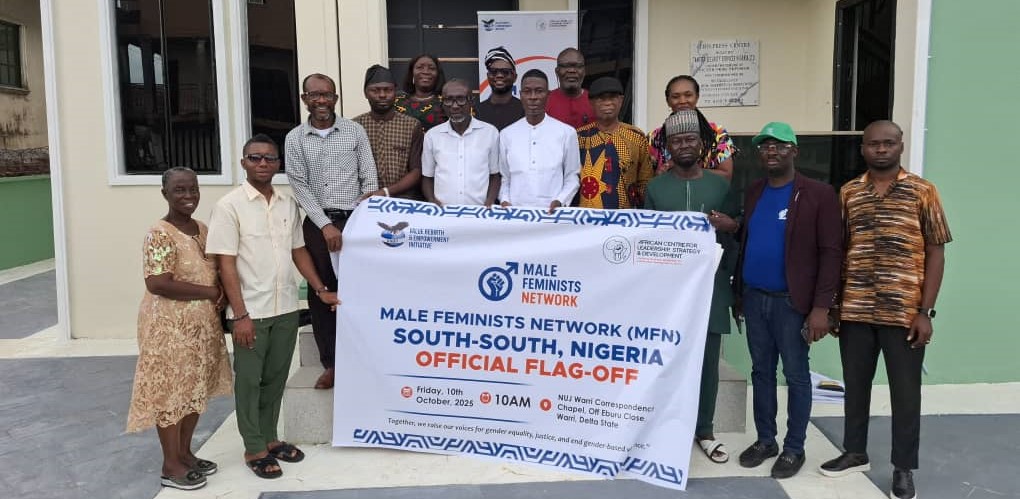
The event, organized by the Value Rebirth and Empowerment Initiative (VREI) in partnership with the African Centre for Leadership, Strategy and Development (Centre LSD), brought together civil society advocates, academics, media practitioners, and community leaders across the region to deliberate on the role of men in advancing feminist principles in Nigeria.
In her opening remarks, Ambassador Peace Edem, representing the South-South Regional Coordination of the MFN, expressed appreciation to the funders, partners, and media practitioners for their support in amplifying the cause of gender equity. He noted that the success of the movement would depend greatly on media participation and storytelling.
“Our gratitude goes to the African Centre for Leadership, Strategy and Development, our funders, and members of the press whose platforms ensure this message travels far,” he said. “We believe that with your help, there will be a paradigm shift in our society toward inclusion and fairness.”
Delivering a presentation on “The Role and Importance of the Media in the Male Feminist Network,” Professor Andrew Agboro, Chairman of the Delta State Civil Society Organisations Forum, described the media as a “powerful catalyst for social transformation.”
He said the press can promote gender justice by shaping public opinion, challenging stereotypes, and ensuring balanced representation in content and newsroom practices. “By using inclusive language, portraying women in diverse roles, and producing gender-sensitive content, the media can dismantle harmful norms and foster equality,” Agboro said.
Agboro also urged media houses to adopt internal policies that promote gender balance and create accountability mechanisms to monitor progress. “When the media leads by example, it becomes easier to influence public attitudes,” he added.
In his keynote address, Ambassador (Pastor) Edewor Egedegbe, Executive Director of VREI, said the creation of the Male Feminist Network was driven by the need to involve men in addressing systemic inequalities.
“It is not enough for women to speak for themselves,” he said. “Men must become allies in the movement for fairness and justice. We are saying to men: be protectors, not perpetrators; partners, not oppressors.”
Egedegbe described the MFN as a “movement of conviction and transformation” aimed at redefining masculinity and empowering men to challenge bias in homes, institutions, and culture.
He highlighted the stark gender gap in Nigeria, noting that the country ranks 130th out of 146 in the Global Gender Gap Report (2023), with women constituting less than five percent of national legislators. “These are not just numbers,” he said. “They represent lives, families, and futures that are constrained by inequality.”
During an interactive session, journalists and participants raised questions about how the network plans to make feminism inclusive for men, tackle structural imbalance, and engage policymakers.
Responding, Egedegbe clarified that the MFN’s goal is to promote “equality through equity.” “Where men enjoy advantages due to societal bias, equity helps level the field so that women can attain the same opportunities,” he said.
The discussion took a personal turn when journalist Foster Akpore, who introduced himself as a male feminist and Media and Public Relations Officer of Orogun Kingdom, described a cultural dilemma in his community where a woman’s leadership claim has sparked controversy in a traditionally patriarchal system.
In response, Egedegbe advised that knowledge must be the starting point for transformation. “This is why the Male Feminist Network was founded—to challenge harmful traditions through education,” he said. “Culture evolves. If a Delta woman can head the World Trade Organization, then a woman can lead a community if she has the capacity.”
Following Akpore’s question, Dr. Otive Igbuzor, Founding Executive Director of African Centre for Leadership, Strategy & Development, who joined the event live on Facebook, lent his voice to the discussion, affirming that knowledge and fairness must guide the movement. “At some point in Urhobo land, every woman was circumcised. Today, it is illegal,” he said. “As a male feminist, you must follow the principles of fairness, equity, and justice. It does not mean supporting a woman when she is wrong.”
The session ended with a consensus that feminism is not a battle of the sexes but a partnership grounded in justice. “When we promote equity,” Egedegbe concluded, “both men and women rise together. In a world created for all, no gender should be subjugated.”
The Male Feminist Network, supported by Centre LSD and VREI, will coordinate activities across Akwa Ibom, Edo, Delta, Bayelsa, Cross River, and Rivers States over the next two years, focusing on training, advocacy, and media engagement to foster gender-balanced development in the South-South region.