
By Foster Akpore | Asaba, Delta State | October 23, 2025
As Nigeria’s real estate sector grapples with inflation, unstable construction costs, and rising rents, experts and policymakers have converged in Asaba to chart a course toward a more stable and inclusive property market.
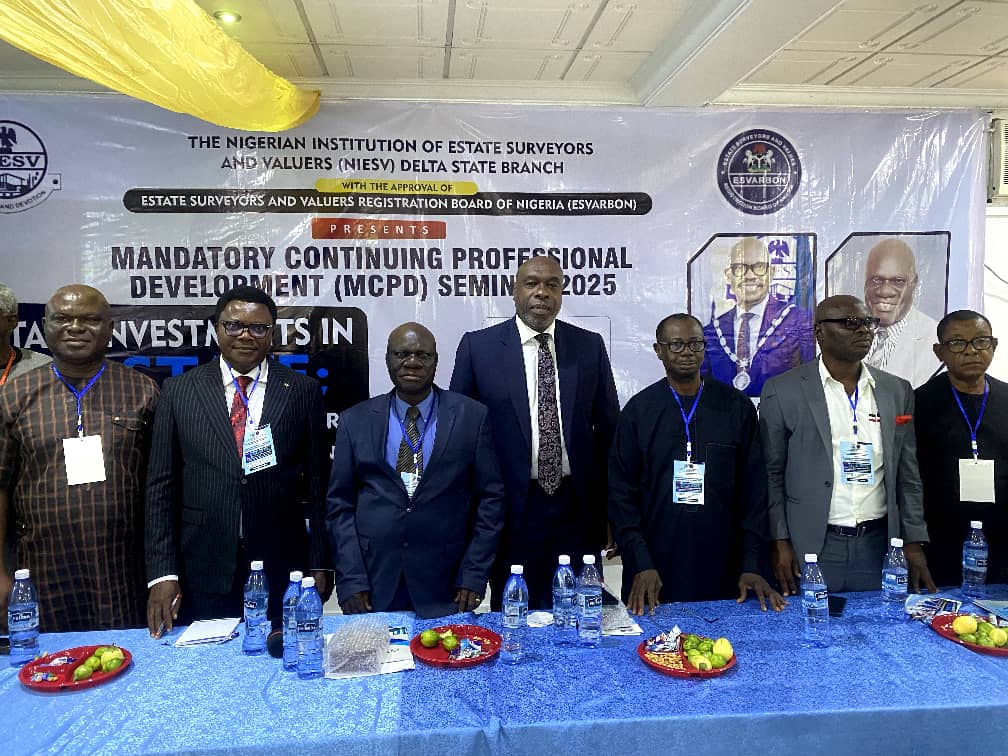
The occasion was the Mandatory Continuing Professional Development (MCPD) Seminar of the Nigerian Institution of Estate Surveyors and Valuers (NIESV), Delta State Branch, held at Orchid Hotels, Asaba.
The theme of the gathering — “Real Estate Investments in Delta State: Costs, Risks, Returns, and Stakeholders’ Responsibilities” — drew seasoned practitioners, academics, and senior government officials.
Delivering the state’s position, the Attorney-General and Commissioner for Justice, Mr Ekemejero Ohwovoriole, SAN, reaffirmed government’s commitment to making housing more affordable.
Ably represented by. Mr. Moses Onoriode Agwere Esq, the Attorney-General, presented a paper titled “The Interventional Mechanisms on High Rent Rises: Delta State Government Perspectives.”
He outlined key measures under Governor Rt. Hon. (Elder) Sheriff Oborevwori’s MORE Agenda to curb rising rents and promote affordable housing, including over 500 new units with REDAN, civil service schemes in Ozoro, Kwale, and Owa-Oyibu, a 10.1-hectare workers’ estate in Ibusa with FMBN, NLC, and TUC, and a proposed rent regulation law slated for public hearing on October 30, 2025.
Ohwovoriole noted that the government has granted land and documentation waivers for the Federal Government’s Renewed Hope Housing Initiative in Warri, and increased civil-service loans and minimum wage to ease the burden of rent.
“Housing is a moral duty as much as an economic necessity,” he said. “Every Deltan deserves a decent and affordable home.”
The Chairman of the Session ESV. (Chief) Paul Osaji reiterated the need for affordable housing which requires the collective efforts of stakeholders and that when more housing is in supply, as it surpasses demands, rent would inevitably dropped.
Esv. (Chief ) P.C Ozili, the State branch Chairman of NIESV Delta Sttae in his address pointed out that the ultimate aim of an investor in a capitalist economy only is profits and that any regulation or rent control is capable of discouraging housing development by the private sector who participate lost in housing delivery.
ESV O. M. Odumah, in his paper “Cost and Value: How Far or Close Apart?”, drew attention to the growing gap between property development cost and market value in Nigeria’s volatile economy.
He warned that inconsistent data, currency devaluation, and speculative pricing are undermining the credibility of property valuations.
“Without reliable market data and current cost indices, even the most skilled valuer is vulnerable to error,” he cautioned.
Odumah called for stronger cooperation between valuers and quantity surveyors, periodic market research, and establishment of a central property data system to support valuation accuracy.
ESV Christian O. O. Omoru (FNIVS, RSV, MNES) explored the delicate subject of rent control in a capitalist economy in his presentation, “Regulation and Rent Control: How Feasible and Enforceable in Real Estate Investment.”
Omoru pointed it out that while regulation can protect tenants, poorly executed policies discourage investors and worsen housing shortages.
He urged Nigeria to design realistic frameworks that balances tenant protection with economic realities to afford a boomerang effect that could worsen the present housing condition.
“Rent control should never be a political slogan,” he said. “It must be a carefully managed economic tool.”
Delivering the lead paper, ESV Chudi S. Ubosi traced the rent crisis in Delta State to escalating building costs, rural-urban migration, and regional insecurity.
He cited how a bag of cement rose from ₦3,000 in 2021 to ₦9,600 in 2025, while a tipper of sand jumped from ₦35,000 to ₦65,000.
The migration of displaced persons from neighbouring states, he noted, has further intensified housing demand in Asaba and Warri.
Ubosi recommended a review of the Land Use Act, expanded mortgage access, and infrastructure investment through public-private partnerships.
From the academic perspective, Dr Idu Egbenta (FNIVS) of the University of Nigeria, Enugu Campus described real estate as the world’s largest store of wealth, combining safety with steady returns.
Presenting “Stakeholders’ Role in Real Estate Investment, Risks and Returns,” he urged stronger synergy among government agencies, financial institutions, developers, landowners, and valuers.
Using data from 2016 to 2024, he compared returns across asset classes and noted that while equities yield higher profits, real estate offers lower volatility and tangible ownership.
He highlighted tenement housing as the highest-return but riskiest segment, reinforcing the maxim: “The higher the risk, the higher the return.”
Earlier in her remark, the Chairman of NIESV National MCPD ESV. AdenreleFatima Olowokure ably represented by ESV. (Dr.) C.C Ihele commended the Delta branch of NIESV for the timely response to the issue of housing shortfall and high rent. He commended participants for their robust contributions and reaffirmed the Institution’s support for state and federal efforts to stabilise the housing market.
The gathering concluded with a vote of thanks from the State MCPD Sub-Committee Chairman ESV. Reward Ugbomoh who8COMMENDED 366d members especially the Chairman of the branch and his able Secretary ESV. Solomon Ehikwe for their supports in ensuring a successful MCPD.