
By Foster Akpore
Effurun-Warri, Delta State. The campaign to engage men as active allies in advancing gender equality gained new ground on November 7, 2025, as the Male Feminist Network (MFN) convened a South-South Training of Trainers (ToT) workshop at Casa De Pedro Hotel, Annex, Effurun-Warri, Delta State.
The event formed part of a national initiative coordinated by the African Centre for Leadership, Strategy and Development (Centre LSD), with support from the Ford Foundation, and implemented in the South-South by Value Rebirth and Empowerment Initiative (VREI).
The workshop brought together a broad spectrum of participants from civil society organisations, the media, religious groups, human rights advocates, traditional leaders, community chiefs, security agents, content creators, and youth mobilizers. The goal was to deepen understanding of feminist principles and build facilitation capacity for cascading gender justice conversations to the grassroots.
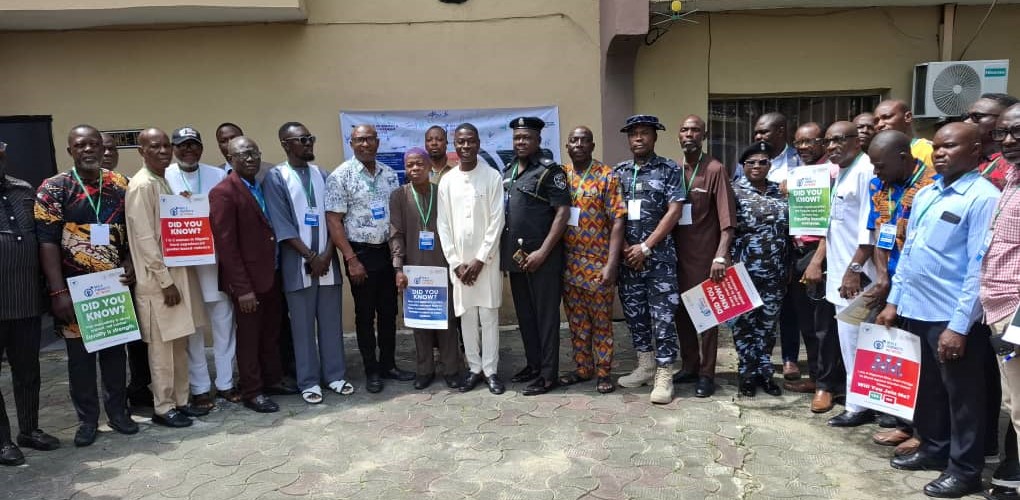
In his opening remarks, Dr. Otive Igbuzor, Founding Executive Director of Centre LSD, described the training as “a journey of transformation, not just influence.” He said the Male Feminist Network project seeks to “transform mindsets to raise men who understand that gender equality is not about taking power from men, but about creating a balanced society where everyone can thrive.”
Dr. Igbuzor emphasized that men must begin to question the ideas handed down through culture and upbringing. “We must unlearn the habits that harm and relearn the values that heal,” he said. “This is why we are training trainers so that from this group, others will learn, and the message will spread to families, communities, and institutions. That is how social change happens one mind at a time.”
He reminded participants that feminism is not a women’s issue but a human one, centered on fairness, respect, and the dignity of all people. “Let us go back and start conversations that challenge inequality wherever we find it,” he urged. “Let us be examples of the kind of men who understand that when women rise, society rises.”
In his goodwill message, Pastor Edewor Egedegbe, Executive Director of VREI, described the gathering as “more than a project, it’s a movement to reshape mindsets, challenge harmful norms, and promote equality, fairness, and justice for all.”
He urged participants to see themselves as multipliers of change, each responsible for spreading the message of equality in their respective spaces. He commended the Ford Foundation’s enduring commitment to gender justice and acknowledged Centre LSD’s coordination of the Male Feminist Network across Nigeria’s six geopolitical zones.
“The journey toward equality requires collective effort,” he said. “The South-South region stands ready to play its part in building a just and inclusive nation.”
The first session, facilitated by Prof. Andrew Agboro, examined Gender-Based Violence (GBV) as one of the most persistent threats to peace, safety, and human development.
He clarified that the discussion was not about controlling women but about addressing harmful acts meant to harm or dominate another person. He outlined forms of physical violence, including hitting, slapping, kicking, burning, and the use of weapons and explained that such acts often overlap with sexual and psychological abuse.
“It is important to note that a person can rape his or her spouse,” he stated. “Marriage does not equal consent. Whether one agrees or not, the law recognizes it as such.”
He added that GBV in Nigeria is sustained by power imbalances, poverty, harmful traditions, and institutional weaknesses, noting that “violence is learned, and anything learned can be unlearned.”
Prof. Agboro shared field experiences from community projects, highlighting instances where women were excluded from key decisions such as siting boreholes. “Ironically, women fetch water every day,” he said. “When they were included, the project succeeded. That is the essence of gender inclusion.”
He praised MFN’s approach of men engaging fellow men as “a powerful model for deconstructing cultural resistance and promoting change.”
The second module, led by Ambassador Peace Edem, explored gender, power, and social norms. He drew attention to how cultural templates shape male and female behavior, often forcing men to hide emotion and women to accept subordination.
“The measure of a man,” he said, “is not in his control over others, but in his respect for equality and justice.”
His session introduced positive masculinity, a model of manhood built on empathy, fairness, and partnership rather than dominance. He urged participants to use their influence to challenge outdated customs, reframe leadership, and promote mutual respect within homes and institutions.
In the third module, Pastor Edewor Egedegbe revisited the meaning of feminism and the role of men in achieving gender equality.
“Engaging men helps us unlearn biases,” he said. “One such bias is the idea that men don’t cry. Someone created that notion, and it became a norm. But we must challenge it. Men can cry, men can be vulnerable, and men can still lead with compassion.”
He clarified that feminism is not a struggle against men but against inequality, adding that it “seeks a society where opportunity is open to all, and merit not gender determines advancement.”
“Equality does not mean sameness,” he explained. “It means fairness. A man’s access is not reduced by helping a woman rise; it only strengthens the community.”
Citing Dr. Ngozi Okonjo-Iweala’s rise to the World Trade Organization as an example of merit-based opportunity, he stressed that “feminism is about access, not preference.”
He also outlined the core principles of feminism meaning equality, equity, justice, respect, and empowerment, explaining that empowerment begins in the mind. “At Value Rebirth, we empower people with knowledge. Once the mind is renewed, quality behavior follows.”
He urged participants to study the Violence Against Persons (Prohibition) Act (VAPP) and educate others on its provisions, noting that ignorance of the law does not exempt violators.
Drawing from biblical context, he referenced Genesis 2:18 to show that man and woman were created to complement each other, not compete. “We must live with a gender-just mindset,” he said. “Live and let’s live together, everyone achieves more.”
In the concluding module, Pastor Egedegbe guided participants through principles of adult learning and facilitation, preparing them to lead community-based step-down trainings.
“Facilitation is not about superiority,” he said. “A teacher tells people what to do, but a facilitator helps them discover truth from their own experience.”
He explained that every participant is expected to cascade the training within their own sphere, whether as a community leader, religious figure, student, journalist, or civil rights advocate.
“This project will run for two years in its first phase,” he added. “We expect that every trainee will step down the knowledge and create at least one ripple of change.”
He emphasized participatory learning, pre- and post-assessment tools, and the importance of modeling non-violent behavior. Sharing a personal note, he said, “In my home, if tension rises, I simply step outside until calm returns. What matters is maintaining peace. That is leadership.”
The session concluded with group action plans, a communique, and personal pledges from participants to replicate the training within their networks.
More than a workshop, the South-South Training of Trainers marked a growing movement of men across Nigeria who are confronting patriarchy and promoting equality as a shared responsibility.
In a closing reflection, Dr. Otive Igbuzor reaffirmed the vision of the Male Feminist Network: “We are building a society that will be better for our daughters and for our sons. Together, we are creating a future where both can rise without one being held down.”
As the Male Feminist Network continues to expand its reach, it is gradually reframing conversations about gender in homes, institutions, and communities one man at a time.