
By Foster Akpore
Effurun-Warri, Delta State — The story began with a goat.
In a quiet Urhobo community of Orogun, a woman once followed an old custom: whenever she overpowered her husband in a quarrel and forced his back to the ground, she was required to buy him a goat. It was tradition. One day, she decided she had bought enough goats. The next time an argument broke out, she dragged her husband to the bed instead of the floor and declared, “Your back didn’t touch the ground, so I’m not buying any goat.”
For Dr. Otive Igbuzor, who witnessed this episode firsthand, the humour carried a message about how people are shaped by culture. Speaking on Friday 7 November, 2025 at the Male Feminist Network Training of Trainers, South-South zone, the development scholar and founder of the African Centre for Leadership, Strategy and Development (Centre LSD) used the story to illustrate how socialization and patriarchy influence behaviour.
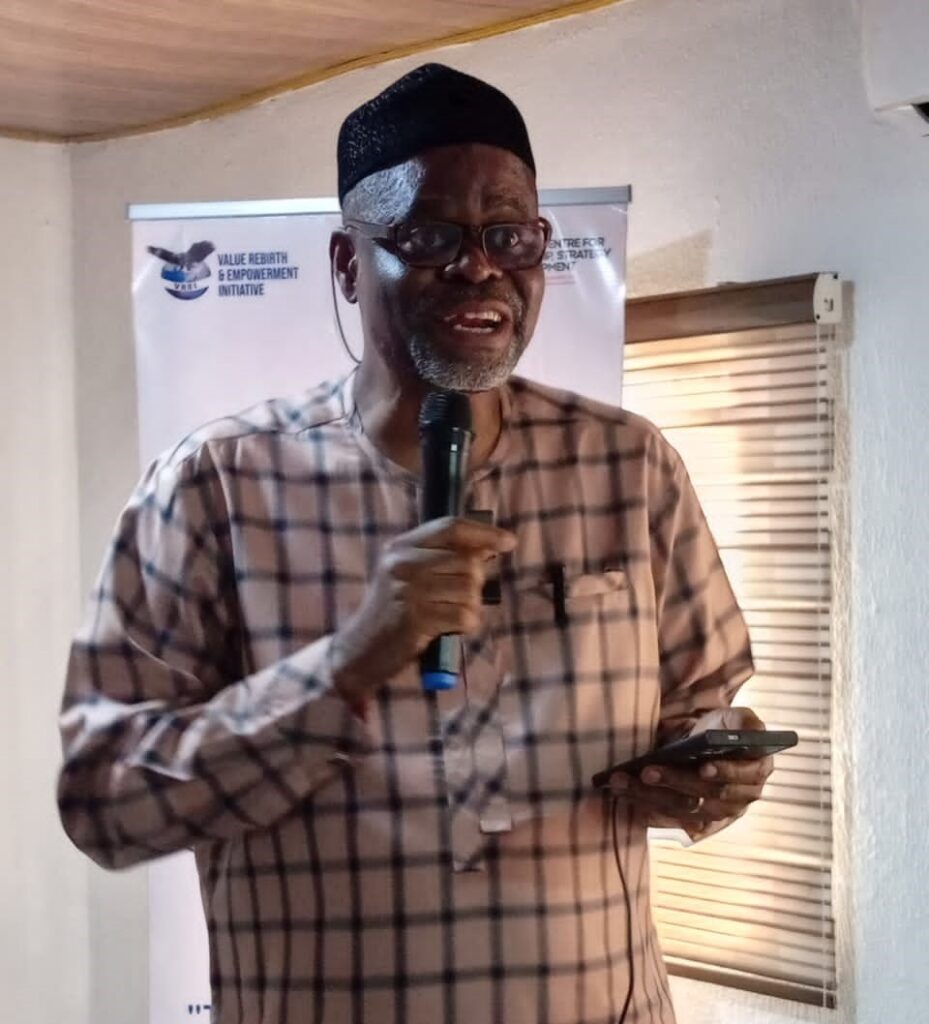
“When you have a whole community where women beat their husbands, it confirms the power of socialization,” he said. “From childhood, people grow up believing it is normal. That is why the kind of work we are doing here is so vital — it helps to reshape the way society thinks.”
Dr. Igbuzor went further to argue that, despite frustrations with governance, Nigeria is advancing in real terms. “Many Nigerians say Obasanjo’s regime was better than Goodluck’s, Goodluck better than Buhari’s, and Buhari better than the current one,” he said. “But if we look closely, humanity is making progress.”
He gave familiar examples. “In 1977, only one person in my family had a car. Today, there are several. In the 1990s, in Maiduguri, flights had barely fifteen passengers; now, our airports are filled. We are building capacity.”
He recalled a time when men could seize another man’s wife openly in the village square without consequence. “Such things no longer happen today,” he said. “That’s progress, even if gradual.”
On the subject of women’s inclusion in local government, Dr. Igbuzor said the system itself remains far from ideal. “I agree that local government chairman and councillors should be elected,” he explained, “but the truth is that even men are being selected. So, why should women be denied the same opportunity?”
Drawing from his home community, he added: “I come from Orogun, an APC stronghold. PDP cannot win an election there in any open contest. Yet, in the last council cycle, all five councillors were PDP. Does APC have one councillor? None. This shows that most of what we call elections are still selections. When true elections come, they will include everyone — men and women alike.”
He concluded with a reflection on feminism, the theme that tied his message together. “Feminism is not sameness; it is fairness,” he said. “It is a movement for equality — equal rights, equal opportunities. It is about balance, not rivalry.”
Measured and reflective, Dr. Igbuzor’s remarks painted a portrait of change that is neither abrupt nor complete, but real — progress that grows, quietly, within the fabric of Nigerian society.