
By Foster Akpore
Southern Delta University (SDU), Ozoro, in collaboration with the Male Feminists Network (MFN), South-South Nigeria, has called on men and boys to take a more active role in promoting gender equality and preventing gender-based violence.
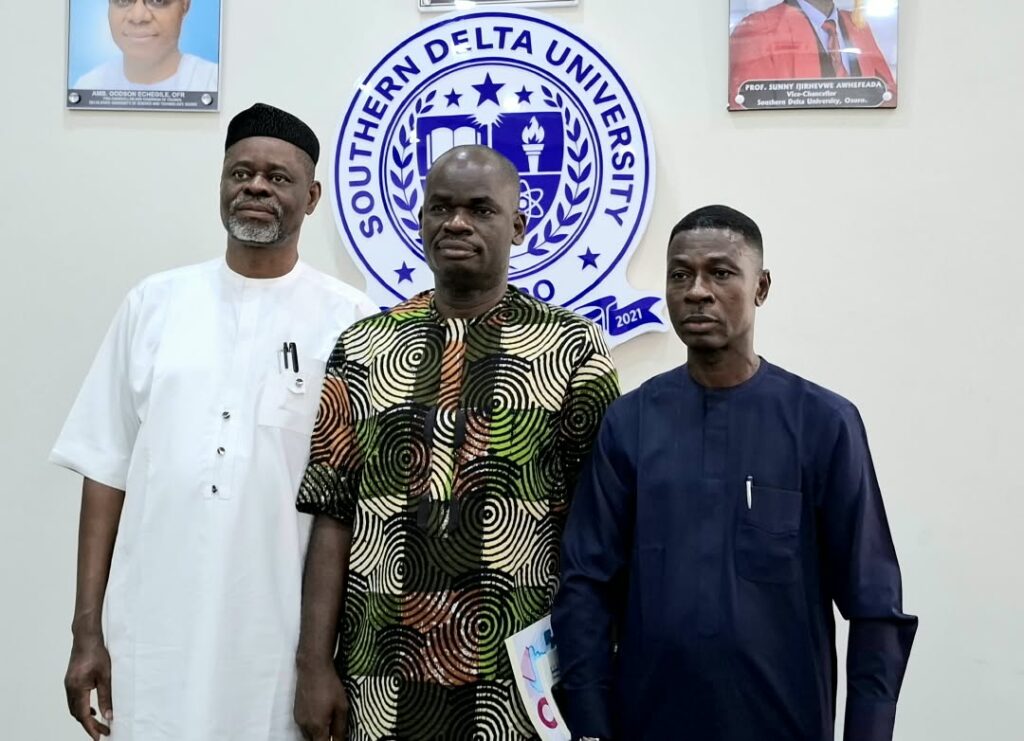
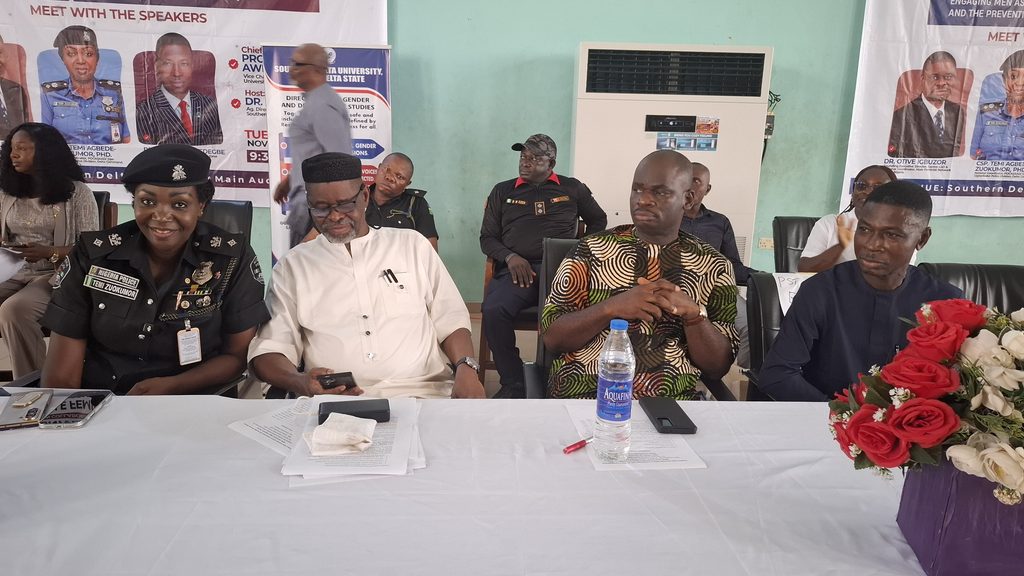
The call was made on Tuesday, November 24, 2026, during a one-day sensitisation programme at the university’s main auditorium. The event, themed “Engaging Men as Allies for Gender Equality, Positive Masculinity and the Prevention of Gender-Based Violence,” brought together university management, staff, students, gender advocates and security professionals.
Declaring the programme open, the Vice-Chancellor, Prof. Sunny Awhefeada, said gender equality was essential to building a better society and required the active participation of both men and women.
“There should be complementarity between the male child and the female child. There should be complementarity between men and women,” he said.
Awhefeada urged Nigerians to work towards building a better country rather than seeing migration as the only route to a better life.
“Those places our people are running to, whether America or Europe, were built by human beings. That is what we also should do in Nigeria,” he said.
He also recalled that discussions on the collaboration began about four months earlier when a delegation led by Pastor Edewor Egedegbe visited the university to explore areas of cooperation.
In his presentation, “Understanding Feminism: Engaging Men as Allies for Gender Equality and GBV Prevention,” Igbuzor, Founding Executive Director of the African Centre for Leadership, Strategy and Development (Centre LSD) and Coordinator of MFN Nigeria, explained that feminism was a movement for justice, equality and human dignity.
He challenged the misconception that feminism was opposed to marriage, religion or family life, arguing that its central concern was the removal of discrimination and unequal power relations.
Igbuzor traced the history of women’s political participation in Nigeria, noting that women were excluded from the 1923 elections under the constitutional arrangements of the period, while voting rights were extended to women across the country by 1979.
He urged the university to establish an MFN chapter on campus and encourage academic engagement with feminism, gender equality and women’s empowerment.
A student of the Department of English and Literary Studies, Ifeanyichukwu Praise Chiemeriem, reinforced the message through a spoken-word presentation that challenged stereotypes about domestic responsibilities, leadership and professional choices. She argued that women should have equal opportunities in fields such as engineering and science, while men should be free to pursue careers in nursing and other professions without discrimination.
Also speaking, the Executive Director of Value Rebirth and Empowerment Initiative and MFN South-South Zonal Coordinator, Pst. Edewor Egedegbe, examined cultural practices that reinforce gender inequality and discussed the role of the Violence Against Persons (Prohibition) law in addressing abuse.
He urged communities to distinguish between cultural values worth preserving and harmful practices that should be abandoned. He identified widowhood practices, female genital mutilation, child marriage, victim-blaming and restrictions on women’s inheritance as examples of practices that undermine dignity and equality.
“Real men protect women. They don’t abuse women,” Egedegbe said.
He called on the university to strengthen its Gender Equality and Gender-Based Violence Prevention Committee, establish clear reporting and referral procedures, and create an MFN chapter to promote positive masculinity among students.
The police perspective was provided by CSP Temi Agbede-Zuokumor, PhD, National Coordinator of Police Community Safety Advocacy and Divisional Police Officer, Ugorikoko Police Station, Delta State.
In her presentation on the role of the Nigeria Police Force in enforcing laws relating to gender-based violence prevention, she challenged the assumption that men could not be victims of domestic abuse.
She recounted the case of a married man who reportedly sought police assistance after being assaulted by his wife but was dismissed by an officer who told him to behave like a man. She used the account to demonstrate how gender stereotypes can prevent victims from receiving the protection they need.
CSP Agbede-Zuokumor called for stronger police-community partnerships, public education and early intervention, particularly in engaging boys and young people. She stressed that reports of abuse should be taken seriously, regardless of the victim’s sex.
“When you see something, say something,” she urged participants.
The programme ended with a vote of thanks by Dr. Esemena Jeroh, Acting Director of Gender and Development Studies, who thanked the university management, resource persons, facilitators and participants. She encouraged students to take the lessons beyond the auditorium and apply them in their faculties, departments and communities.
The programme underscored the need for men and boys to challenge discrimination, reject violence and promote equal dignity, while universities and other institutions strengthen the systems needed to prevent and respond to gender-based violence.