
By Foster Akpore | Asaba, Delta State | October 23, 2025
A Fellow of the Nigerian Institution of Estate Surveyors and Valuers (NIESV), ESV. Christian O. O. Omoru has called for a pragmatic and context-driven approach to rent regulation in Nigeria, warning that blanket rent control policies could worsen the housing crisis rather than solve it.
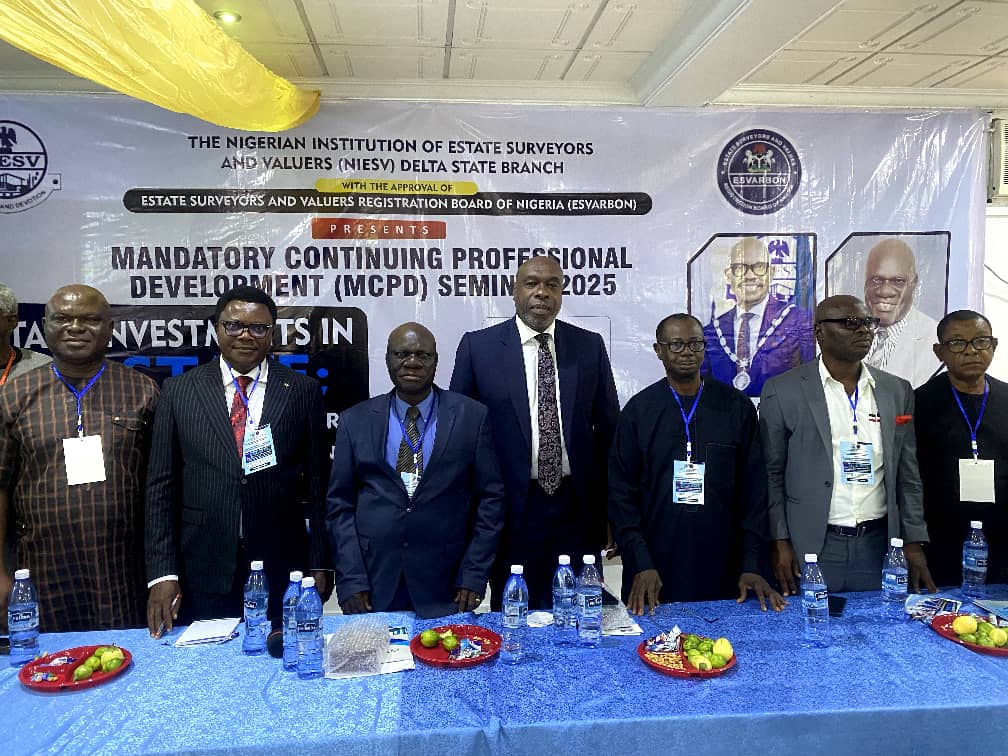
Omoru made this submission while presenting a paper titled “Regulation and Rent Control: How Feasible and Enforceable in the Real Estate Investment in a Capitalist Economy” at the 2025 Mandatory Continuing Professional Development (MCPD) Workshop of the NIESV, Delta State Branch, held at Orchid Hotels, Asaba.
He observed that Nigeria’s urban housing deficit continues to deepen due to rural-urban migration, inflation, high construction costs, and poor housing policy, leading to escalating rents across cities with consequential skyrocketing rents. While some states have attempted to intervene through tenancy laws and real estate regulations, Omoru noted that such measures often fail when they neglect broader economic realities arising from the interaction of the forces of demand and supply.
Drawing from examples in Germany, the United States, Canada where rent control subsist, and the United Kingdom where there are no rent control measure, he explained that rent control provides only temporary relief, as it can discourage investment and reduce housing supply. He emphasized that Nigeria’s economy, though described as capitalist, functions as a mixed system in which government not only participates but also regulates private enterprise.
According to Omoru, any rent regulation framework in Nigeria must be feasible, enforceable, and harmonized with constitutional provisions that separate professional practice from state-level legislation. He cited the Lagos State Real Estate Regulatory Authority Law and the Tenancy Law as cases that, despite good intentions, face implementation challenges due to overlapping jurisdiction and lack of adequate consultation.
He outlined multiple causes of rising rents, including inadequate housing supply, poor land-use planning, unlawful demolitions, weak resettlement systems, urbanization, gentrification, and quackery in real estate practice. He added that rent increases are element of increase land value due to development as in the case of the MORE agenda of Delta State Government and landlords often pass maintenance costs and high land prices to tenants, further straining affordability.
Omoru recommended that governments at all levels prioritize expanding affordable housing, robust and strategic land use policy and enforcement that will impose monetary sanctions on defaulters for housing impairment. That such housing impairment funds can be geared towards providing affordable housing. He added that government should make policy to ensure any estate or property development of over three units are made to provide 25% of the total accommodation units for low income earners before plan approval. He maintained that genuine rent control must go hand in hand with increased supply, professional regulation, and transparent governance.
He concluded that “regulation and rent control can only succeed if designed within Nigeria’s economic and institutional realities, and if implemented collaboratively between government, professionals, and the private sector.”