
By Foster Akpore
YENAGOA — Stakeholders drawn from government, academia, traditional institutions, the media and civil society have called for the institutionalisation of a legally backed development plan for Bayelsa State to guarantee policy continuity and safeguard strategic infrastructure projects beyond political administrations.
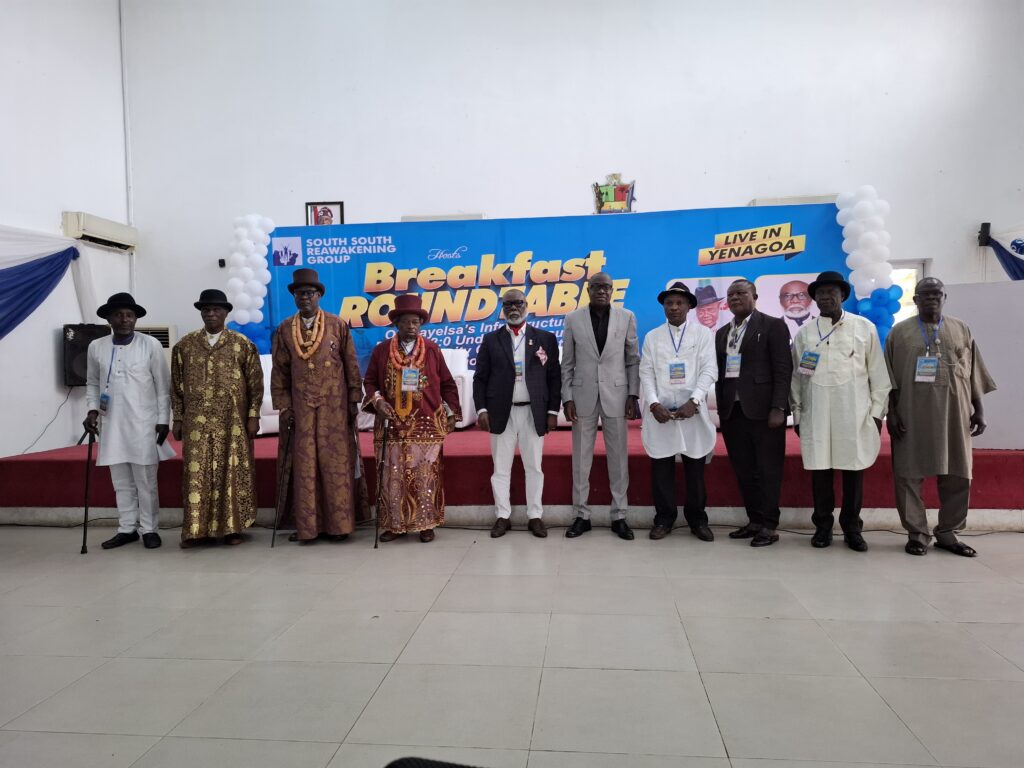
The call formed the highlight of deliberations at the Bayelsa Infrastructure Rebirth 2.0 Breakfast Roundtable, organised by the South-South Reawakening Group (SSRG) on Monday 13 July, 2026 in Yenagoa under the theme, “Bayelsa’s Infrastructure Rebirth 2.0 Under the ASSURED Prosperity Government of Governor Douye Diri.”
The forum, attended by the Secretary to the Bayelsa State Government, Prof. Nimibofa Ayawei, traditional rulers, academics, policy analysts, media professionals and development stakeholders, examined the state’s infrastructure trajectory and its implications for economic growth, investment and sustainable development.
Convener of the forum, Joseph Ambakederimo, said the objective of the engagement was to provide an independent platform for assessing government policies while creating greater public awareness of ongoing development efforts.
According to him, governance thrives when citizens are adequately informed about government programmes and are given opportunities to participate in policy conversations.
He argued that infrastructure development extends beyond physical construction to creating opportunities for economic growth, social inclusion and improved quality of life.
“We must continue to engage our people on governance. When citizens understand government policies and projects, they become partners in development rather than spectators,” Ambakederimo said.
A major feature of the event was the presentation by Secretary to the Bayelsa State Government, Prof. Nimibofa Ayawei, who described infrastructure as an economic investment rather than merely a social intervention.
Ayawei cited the ongoing Brass Road project as a strategic investment capable of transforming Bayelsa into a major offshore logistics hub.
According to him, Bayelsa hosts some of Nigeria’s largest offshore oil assets but derives limited economic benefits because logistics operations are largely coordinated from neighbouring states.
“The objective is not simply to connect Brass by road,” he said. “The real value lies in the economic opportunities the road will unlock. It will attract marine logistics, offshore support services, hospitality investments, employment and significantly improve internally generated revenue.”
He maintained that infrastructure planning must be driven by long-term economic value rather than short-term political considerations.
Dean of the Faculty of Basic and Applied Sciences, Niger Delta University, Prof. Francis Sikoki, traced the developmental challenges of the Niger Delta to the recommendations of the 1957 Willink Commission, which acknowledged the region’s historical neglect.
He noted that although successive administrations had contributed to Bayelsa’s growth since the state’s creation, the current administration had distinguished itself by sustaining inherited projects while initiating new ones.
Sikoki, however, stressed that sustainable development would require a comprehensive development plan backed by law.
“A state development plan should outlive governments. It should become a framework that every administration is obligated to implement so that development remains consistent,” he said.
He also advocated the establishment of a specialised infrastructure maintenance agency to preserve public assets and promote a stronger maintenance culture.
Veteran journalist and former Bureau Chief of Daily Independent, Daniel Abia, said Bayelsa had undergone noticeable physical transformation, citing improvements in urban renewal, transportation infrastructure and public security.
He warned that many development initiatives across Nigeria had failed because successive administrations abandoned projects initiated by their predecessors.
According to Abia, the Bayelsa State House of Assembly should enact legislation compelling future administrations to implement an agreed development blueprint irrespective of political differences.
“The greatest challenge to development in Nigeria is policy discontinuity. Once projects are protected by law, governments will have little room to abandon them,” he said.
Abia also urged government to revive the long-abandoned iconic tower hotel project in Yenagoa, describing it as a potential catalyst for tourism, hospitality and conference business in the state.
Public affairs analyst and publisher, Hon. Charles Eni-Umukoro, described electricity as the foundation of industrialisation, commending the state’s investment in power infrastructure, particularly the gas turbine project.
He called on residents to protect public infrastructure from vandalism, insisting that development could only be sustained through collective ownership.
“Government projects belong to the people. Protecting them is protecting our collective investment,” he said.
He equally advocated a structured development framework that would ensure continuity in infrastructure delivery irrespective of changes in government.
During the interactive session, participants echoed similar concerns, particularly on abandoned projects, infrastructure maintenance and long-term planning.
The Ofor Igbiki of Ogbema Community in Nembe Local Government Area, HRH Douglas Onungu, appealed for the completion of the abandoned Okoroba–Okpoama Road project, describing it as critical to economic activities in oil-producing communities.
President of the Rivers State University Alumni Association and President of the Catholic Women Organisation of Nigeria, Benin Province, Dr. Perekebina Kimia Berezi, applauded investments in higher education and aviation infrastructure, saying the expansion of tertiary institutions and improved flight operations had enhanced educational opportunities and accessibility to the state.
Similarly, Associate Professor Helen Opigo of the Federal University Otuoke urged government to prioritise the completion of the iconic tower hotel in Yenagoa, arguing that the facility would stimulate tourism, conferences and employment.
Another participant, Mrs. Victoria Fred, advocated stronger supervision of public utilities, particularly water infrastructure, to prevent vandalism and ensure sustainability.
Participants also urged government to accelerate work on strategic projects, including the proposed Agge Deep Seaport, the Brass Road corridor, electricity expansion and the proposed Airport City and Special Economic Zone, describing them as critical to Bayelsa’s economic diversification agenda.
The forum further advocated true federalism and fiscal federalism, arguing that increased sub-national fiscal autonomy would enable resource-producing states to invest more aggressively in infrastructure and economic development.
At the end of the roundtable, stakeholders adopted a communiqué recommending the enactment of a legally enforceable Bayelsa Development Plan, the establishment of a dedicated infrastructure maintenance framework, stronger protection of public assets, completion of viable abandoned projects, expansion of electricity and water infrastructure, and sustained investment in education, healthcare, agriculture and transportation.
In his closing remarks, Ambakederimo said the South-South Reawakening Group would continue to provide a non-partisan platform for policy dialogue and public accountability.
He added that future editions of the Infrastructure Rebirth Roundtable would periodically assess development milestones and offer constructive recommendations aimed at deepening governance and sustainable development in Bayelsa State.