
By Foster Akpore | Aragba-Orogun, Delta State
The harmattan had long given way to the rains, but on the morning of Friday, 26th June 2026, it was as though the skies themselves paused in deference. At St. Joseph’s Catholic Church, Aragba-Orogun, a congregation unlike any ordinary Friday gathering assembled in the quiet dignity of grief and gratitude — chiefs in full ceremonial regalia, Catholic clergy in white vestments, family across continents, and the ordinary men and women of Orogun Kingdom who had simply come to say goodbye to the man they all, in one way or another, called “Daddy.”
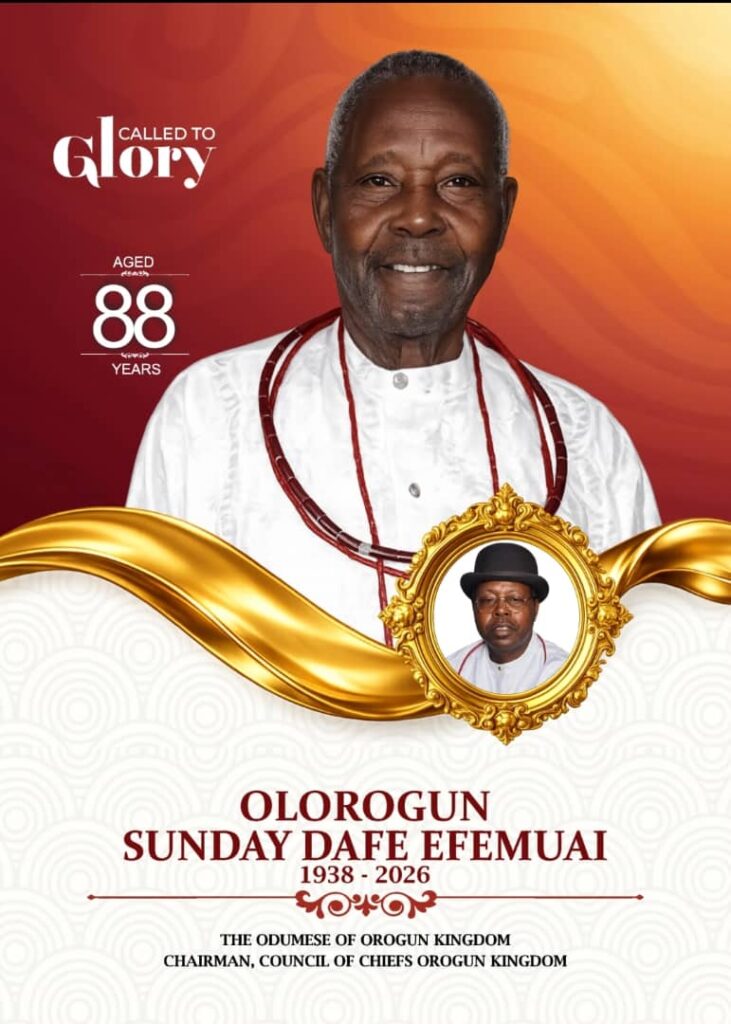
Olorogun Sunday Dafe Efemuai — the Odumese of Orogun Kingdom, Chairman of the Orogun Traditional Council of Chiefs, engineer, teacher, patriarch, and devout Catholic — had died as he had lived: fully, completely, and surrounded by love. He was 88 years old.
Between the Stool and the Sanctuary
To understand the weight of this farewell, one must first understand the man it honoured.
Born on 21st January 1939 in Aragba-Orogun to Papa Okwuenu Efemuai and Madam Oghenekevwe of the Abene family, Sunday Dafe Efemuai came into a world that would demand much of him — and he would give it everything. The family relocated early to Ikiere in present-day Oyo State, and it was there, absorbing Yoruba language and culture alongside his Urhobo roots, that the young Sunday developed what those who knew him described as an unusual gift: the ability to belong anywhere. He could walk into any room — a chiefs’ council, a church hall, a dancefloor — and become its centre of gravity.
His mother gave him compassion; his father gave him principle. As the third of seven children, positioned naturally between younger and older siblings, he became a mediator before he was ever a chief. It was perhaps destiny rehearsing him for the role he would one day formally hold.
His education took him from Ikiere to The Polytechnic, Ibadan, where he studied Mechanical and Instrumentation Engineering. But before he became the engineer, he was the teacher — at Atamakolomi School in Effurun and, notably, at the prestigious Hussey College, Warri. Those who sat in his classrooms have not forgotten him. He was, by every account, the kind of teacher whose influence extends well past the subject matter.
His engineering career traced a distinguished arc — the National Electric Power Authority, the Ughelli Glass Factory, and then Shell Nigeria, where he spent over a decade designing and maintaining critical operational systems. After Shell, he worked independently across flow stations and oil infrastructure across the region. Wherever he went, his reputation arrived first: technical excellence, reliability, integrity.
“I Lead and Others Follow”
In 1988, Orogun Kingdom honoured what the community had long observed in the man. Sunday Dafe Efemuai was conferred the chieftaincy title of Odumese of Orogun — a title whose meaning, I lead and others follow, could not have been more precisely chosen. He later rose to serve as Chairman of the Orogun Traditional Council of Chiefs, the highest institutional expression of traditional authority in the kingdom.
On the morning of his funeral, the Council was present in full force. Chiefs, resplendent in dignified white robes and their characteristic blue capes, who had served alongside him, debated with him, and followed his lead through the complexities of community governance, took their places in the church and at the graveside, bearing the weight of an era’s passing upon their shoulders. The Chairman of their brotherhood was gone, and the silence where his voice had once resounded was immense.
Those who have observed Orogun Kingdom’s traditional governance speak of Olorogun Efemuai as a chairman who understood that authority, to mean anything, must be rooted in service. He supported young people through education quietly and without expectation of recognition. He was, in the language of his community, a man who spent himself freely.
Two Nights Before: The Vigil at Aragba
The formal farewell began two evenings earlier, on Wednesday, 24 June, when a Vigil Mass was held at St. Anthony’s Catholic Church, Ugborikoko-Effurun. The church was filled with candlelight and voices as the ancient prayers of the Catholic tradition rose like incense, marking the beginning of the final rites before his journey home to Aragba-Orogun.
The liturgy that evening was chosen with care — Psalm 121, I lift my eyes to the hills; Psalm 130, the De Profundis, that most human of cries from the depths; and the great Canticle from Philippians, proclaiming Christ who emptied himself and was exalted. Job’s defiant declaration — I know that my Redeemer lives — rang across the nave, a reading that seemed almost written for a man who had lived through colonial Nigeria, independence, civil war, and eight decades of a nation still finding itself, and had kept his faith through all of it.
The recessional hymn, Now Thank We All Our God, was not ironic. It was sincere. This was a life that warranted thanksgiving.
Friday Morning: The Funeral Mass
By 10am on Friday, St. Joseph’s Catholic Church was filled to its edges. The clergy assembled was itself a statement of the regard in which Olorogun Efemuai was held: Most Reverend Anthony Ovayero Ewherido, the Bishop, presided — joined by Very Reverend Fathers Anthony Anamali, Godwin Orudje, Joachim Ukutsemuya, and Benedict Ukutegbe, alongside Reverend Fathers Gerald Oki and Christian Igwe, and all priests present. It was an ecclesiastical gathering befitting a man whose Catholic faith was, as his family would attest, not ornamental but constitutional.
The readings struck the profound chords of Christian hope. From the Book of Wisdom: “the souls of the righteous are in the hand of God”. From Paul’s letter to the Romans: “whether we live or whether we die, we belong to the Lord”. And then the Gospel of John — the raising of Lazarus — with its thunderclap declaration from the mouth of Christ himself: “I am the resurrection and the life.”
The homily drew from a life fully lived. Here was a man, the congregation was reminded, who had led both by title and by example. Who had insisted on evening prayers as a non-negotiable family ritual. Who had laid hands on his children’s heads and prayed over them every time they visited. Who had attended Mass faithfully, decade upon decade, and raised sixteen children in the Catholic tradition.
The offertory hymn, “Abide With Me”, drifted through the nave — that Victorian plea for divine presence in the face of darkness and death, sung here not in despair but in confidence. Communion was accompanied by “OHappy Home”, an Urhobo hymn carrying the community’s own voice into the sacred moment, and then “I Am the Bread of Life” — a summation of everything the ‘Eucharist’, and indeed the life of this man, had pointed toward.
The recessional hymn, “God Be With You Till We Meet Again”, was both farewell and promise.
The Family Speaks
If the church represented one dimension of Olorogun Efemuai’s life, the family tributes represented another — rawer, more intimate, and no less magnificent.
His wife, Mrs. Martina Efemuai, who stood beside him for over sixty years, wrote with the simplicity that only the deepest love produces: “You were my strength, my joy, my home. Rest well my crown and my love.”
His first daughter, Mrs. Philomena Isiboge, recalled his habit of giving each child a special name — hers was ‘Ore gene gene’, my number one — and his lifelong instruction: “I beg my daughter, make una no divide o. Whatever it is you do that brings them together, keep doing it.” She has, she says, carried those words through the years. She will carry them still.
A grandson remembered calling him “Soldier and Young man” — capturing in two nicknames the vigour and uprightness that defined him. A granddaughter recalled him waiting at the gate, patient and watchful, for her return from the hairdresser — a small, enormous act of love. A daughter-in-law, based in Ireland, remembered him walking her daughters to school on visits, slipping them money for ice cream, joking about wanting to eat ‘mede mede’. He was, in these moments, not the ‘Odumese’ or the Council Chairman. He was simply, irreplaceably, ‘Daadi’.
He is survived by his wife Martina, sixteen children, several grandchildren, and a great-grandson.
What Orogun Has Lost
Orogun Kingdom has lost its ‘Odumese’. The Council of Chiefs has lost its chairman. The Catholic Church in Aragba has lost one of its most faithful sons. And the countless young men and women he quietly sponsored through education — many of whom may never have known the full extent of his hand in their futures — have lost a silent benefactor.
But loss, in this tradition and in this faith, is never the final word.
“He carried the kingdom on one shoulder and a rosary in the other,” Chief (Barr.) E.T. Opone, President General of Orogun Kingdom, remarked quietly outside the church. “He never once let either fall.”
The engineer who built things. The teacher who formed minds. The chief who served without swagger. The father who prayed over his children’s heads. The husband who was, for sixty years, someone’s crown and home.
One man. Fully lived.
Olorogun Sunday Dafe Efemuai. 1939–2026. Rest eternal.