YENAGOA, BAYELSA STATE — August 15, 2026
By Foster Akpore
Elder statesman and foremost South-South leader, Comrade Joseph Ambakederimo, has renewed the call for resource control and comprehensive restructuring of Nigeria, insisting that the country needs a federal system based on equity, fairness and greater economic autonomy for its federating units.
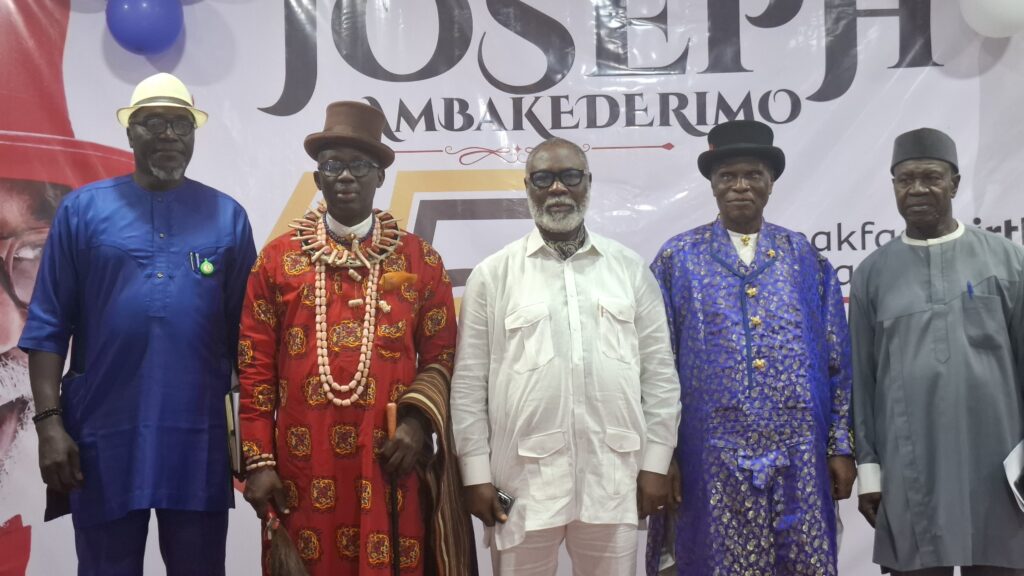
Ambakederimo spoke at his 65th Birthday Breakfast Media Chat, themed “Federalism with Equity: Fair Resources, Fair Opportunities.”
He said the annual engagement, which he has used for about three decades to discuss national issues, was deliberately brought home to the Niger Delta to deepen conversations about the region and Nigeria.
“Do we have fair resources in Nigeria? For me, I don’t think so. Do we have fair opportunities? Again, I don’t think so,” he said.
According to him, resource control is not a demand peculiar to the Niger Delta but a national question that should concern every part of the federation.
“Resource control is not a Niger Delta problem. It is a Nigerian issue.”
Ambakederimo argued that Nigeria’s highly centralised system has created dependency among states and local governments, while limiting their capacity to develop according to their resources and priorities.
He advocated a comprehensive restructuring based substantially on the principles of the 1963 Constitution, proposing that states should retain 70 per cent of revenues derived from resources within their territories while contributing an agreed percentage to the centre.
He also dismissed what he described as piecemeal reforms, insisting that the country must address the fundamental structure of the federation.
“We must rethink our federation. We must retool Nigeria. We must restore equity. We must create fair opportunities.”
Niger Delta’s environmental burden
Contributing to the panel, Prof. Francis David Sikoki, who is a University of Port Harcourt fisheries and marine science professor, known for his work on marine pollution monitoring and environmental research in the Niger Delta, highlighted the environmental consequences of decades of oil exploration, particularly gas flaring, oil spills and the destruction of fishing and farming livelihoods.
“For over 70 years, they have been flaring gas, burning away a resource that is very precious, that could transform the entire Niger Delta region to a paradise.”
He said the region had continued to bear the environmental cost of oil production without receiving commensurate benefits.
“Fishermen go to fish all day and don’t catch a single fish. Something that we depend on very greatly for our well-being is gone.”
Sikoki argued that many government interventions had failed to address the underlying problems.
“Many of these things are cosmetics. The actual issues and problems are not being addressed.”
Morris: Niger Delta governments must do more
Environmental activist Alaogoa Morris challenged Niger Delta governments to become more proactive in defending the region’s interests during national policy processes.
“The Niger Delta governments have not done enough for our people in terms of the agitations.”
Morris also warned that continued failure to address the region’s grievances could produce renewed agitation.
“Nigeria should listen because after a time another set of agitation might come, and it might not be too good for us.”
He called for greater resources to be directed towards host communities rather than excessive spending on security operations.
“Why not channel this money to our communities? Let them use it to train their children, to provide services, transport, good healthcare, to support and complement government efforts.”
He ended with a direct appeal for environmental and social justice.
“Do justice socially and environmentally to the people of the Niger Delta. Give us true fiscal federalism.”
King Dakolo: “That is stealing. That is robbery”
The royal father, King Bubaraye Dakolo (Agada IV) is the Ibenanaowei of Ekpetiama Kingdom, who is also Chairman of the Bayelsa State Traditional Rulers Council and Chairman of the Conference of Ijaw Traditional Rulers and Elders, provided a historical perspective on the resource-control struggle, recalling the 1966 revolution led by Isaac Adaka Boro and subsequent changes in Nigeria’s fiscal structure.
He said history was necessary to understand the roots of the present struggle.
“A bit of history, I think, is always necessary because it gives perspective.”
Using an analogy of a hunter who kills an elephant only for the proceeds to be distributed elsewhere, King Dakolo questioned a system in which resource-producing areas receive what he considers an inadequate share.
“That is seeming to be Nigeria’s story, and so that is particularly painful and not acceptable.”
The traditional ruler also linked the management of Nigeria’s oil wealth to the country’s wider security challenges, arguing that communities producing crude oil should not simultaneously suffer deprivation.
His strongest criticism was directed at the current revenue-sharing structure.
“They are taking our oil and gas resources to share into 774 places and giving us eight parts. That is stealing. That is robbery, and we are not seeming to talk about it enough.”
A national conversation
The speakers agreed that the resource-control debate should move beyond the Niger Delta and become part of a broader national conversation on the structure of Nigeria.
Ambakederimo maintained that greater fiscal autonomy would allow states to compete positively, attract investment and develop infrastructure, education, healthcare and human capital according to their circumstances.
He urged Nigerians to continue the conversation through democratic engagement and within the ambit of the law.
“We must continue talking. We must continue engaging. We must continue demanding reforms within the ambit of the law.”
He said the ultimate objective was not simply greater revenue for the Niger Delta but a more balanced federation capable of giving every part of Nigeria a genuine opportunity to prosper.
The event ended with renewed calls for true federalism, resource control, environmental justice and a more equitable distribution of national resources.
The central message was clear: according to the speakers, Nigeria cannot achieve sustainable development without confronting the structural imbalance at the heart of its federal system.