
By Foster Akpore
There was a remarkable coincidence in Delta State on Tuesday, August 25, 2026.
On the day the world mourned Dolly Parton, the American country music legend whose childhood poverty inspired Coat of Many Colors and whose later life became closely associated with childhood literacy, Egini in Udu Local Government Area was opening a new chapter of its own.
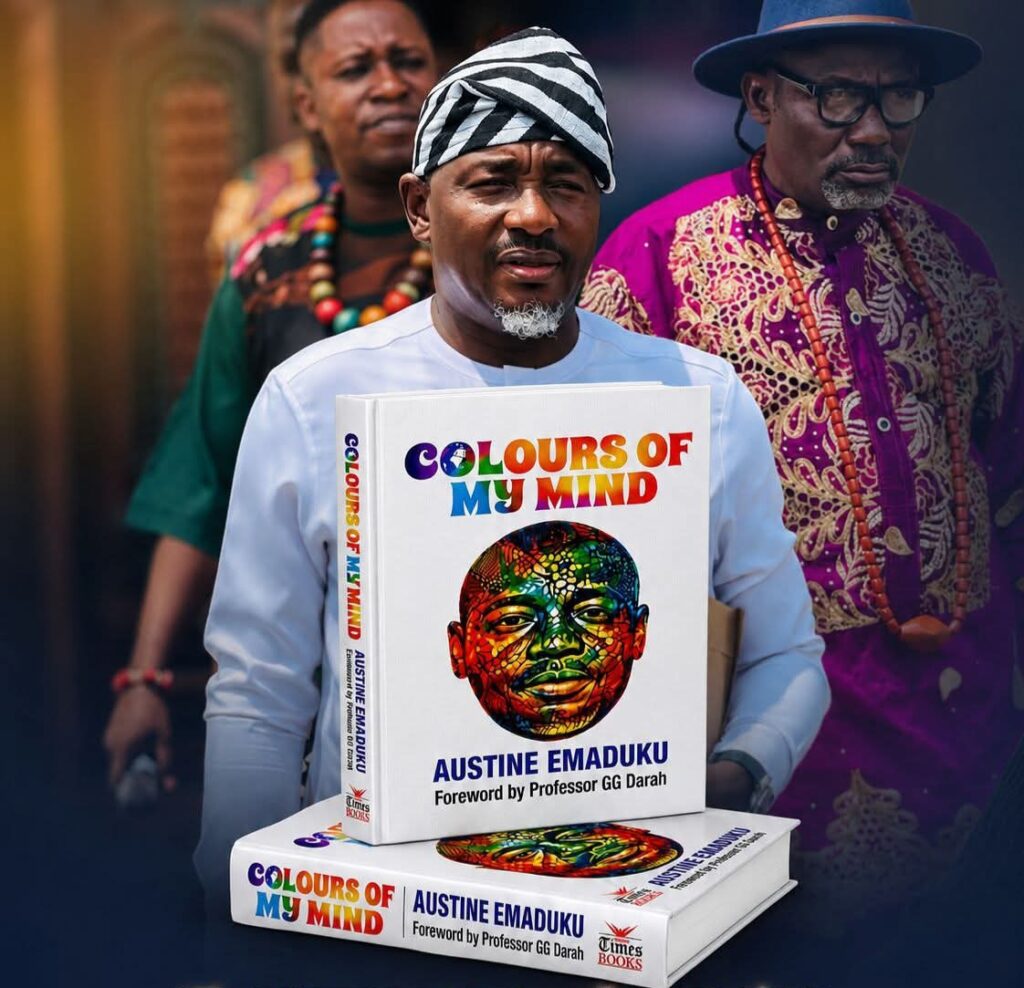
At the Egini Community Town Hall, Chief Dr. Austin Emaduku presented his 275-page book, Colours of My Mind, and formally opened the Egini Community Public Library, a facility he donated to the public to mark his birthday.
There is no evidence that the two events were connected. Yet the coincidence provides a remarkable opportunity to reflect on the relationship between poverty, books, education and the responsibilities of those who have the means to give back.
Dolly Parton’s Coat of Many Colors was born from a childhood experience of poverty. Her mother made her a coat from pieces of discarded cloth. To the outside world, such a coat could have represented deprivation. To the young Dolly, it represented her mother’s love, sacrifice and dignity.
Decades later, that same child who grew up with very little would establish the Imagination Library, a programme that provides free books to young children. Her father’s difficulty with reading and writing helped shape her appreciation of literacy and the opportunities that books can provide.
That journey from Coat of Many Colors to the Imagination Library offers a powerful lesson. Poverty can restrict what a child possesses, but it should never be allowed to determine what that child can learn, imagine or become.
It is a lesson that resonates strongly with what Emaduku has done in Egini.
Colours of My Mind is, in many respects, an intellectual record of the author’s engagement with his society. Published by Premium Times Books, the volume contains 69 articles examining contemporary issues affecting Udu, the Urhobo nation, the Niger Delta and Nigeria. Its subjects include politics, governance, culture, religion, human rights and the challenges confronting communities.
Professor G.G. Darah, one of Nigeria’s respected scholars and literary critics, described Colours of My Mind as a literary masterpiece and encouraged Emaduku to continue producing works that interrogate contemporary issues and stimulate intellectual engagement.
Mr. Emmanuel Ogheneochuko Arodovwe, of the Department of Philosophy, Delta State University, Abraka who reviewed the book, described its language as lucid and simple while noting the depth of the ideas contained in the work. He presented Emaduku as a social commentator whose writings reflect sustained engagement with the realities around him.
But perhaps the most important decision surrounding Colours of My Mind was not what Emaduku wrote in the book. It was what he chose to build around it.
He donated a public library.
In his welcome remarks, Emaduku explained that the library was, in his view, the most important part of the ceremony.
He said the journey towards establishing the library began in 2023 during his tenure as President-General of Udu Kingdom, when he provided and fitted the space within one of the rooms of the Egini Community Town Hall with bookshelves and reading pews and stocked it with books. He acknowledged the community leadership and his childhood friends for making the space available, as well as the memory of his late brother.
For Emaduku, the purpose is clear. He wants to revive reading among youths and adults in Egini and other Udu communities while helping people who, for economic reasons, cannot easily obtain reading materials.
The library has been stocked with 600 books and equipped with a 4.2 KVA solar inverter, providing 24-hour power supply, as well as air conditioning. Emaduku described the facility as an environment designed to provide an escape from distraction and create suitable conditions for reading and research.
He described the library as a “mustard seed”, expressing the hope that it would eventually put Egini and Udu on the world map.
That vision deserves serious attention.
A library cannot, by itself, eliminate poverty. But it can remove one of poverty’s barriers by giving children and young people access to books, knowledge and opportunities to learn.
The Egini project therefore represents more than a philanthropic donation. It is an attempt to create an institution that can continue serving the community long after the opening ceremony has ended.
FROM COAT OF MANY COLORS TO COLOURS OF MY MIND
This is where the connection between Dolly Parton’s Coat of Many Colors and Emaduku’s Colours of My Mind becomes particularly meaningful.
Dolly’s coat was made from scraps because that was what her family could afford. Yet it became a symbol of love and dignity.
Colours of My Mind is a collection of ideas shaped by years of observation, activism and engagement with society. The Egini library now provides a place where those ideas, along with the works of other writers, can encounter new minds.
One is a story about the colours of a child’s coat.
The other is about the colours of an adult’s mind.
Both remind us that what appears ordinary can carry extraordinary meaning.
Emaduku also explained that the book represents a reflection of his life and interventions on national issues between 2015 and 2023. He described the work as a weaving together of his views, social commentary and fictional writings around the experience of living in community.
He acknowledged several people who encouraged the book’s journey, including Dr. Chido Onumah, whom he credited with conceiving the idea of gathering his writings, arranging the articles, reading the manuscript and introducing him to the publisher.
He also acknowledged Professor Godwin Darah for his encouragement and for accepting to chair the event, saying that having Darah’s name on the cover was an endorsement of considerable value.
The library and the book therefore emerged from the same intellectual conviction: that ideas should be preserved, shared and made available to future generations.
THE BOOK LEAVES EGINI
The initiative becomes even more encouraging because Colours of My Mind is already travelling beyond Egini.
Nigerian-American writer E. C. Osondu, an internationally recognised author and Professor of English at Providence College, Rhode Island, United States, purchased and donated 10 copies of Colours of My Mind for secondary schools in Urhobo land. The books are expected to be delivered to the benefiting schools through the Chairman of the Association of Local Governments of Nigeria.
That gesture reinforces the principle behind the library. Books should circulate.
They should enter classrooms, libraries and homes. They should be read by students who may agree with the author, question his arguments or find ideas that inspire their own writing.
A book should not end with its launch.
Its journey begins when a reader opens it.
THE SAME ANNUAL LITERARY AWARDS
Emaduku has also taken the literacy project beyond the provision of books by establishing the Salor and Mabel Emaduku Annual Literary Awards, known as the SAME Annual Literary Awards.
The first initiative under the programme will be an essay-writing competition involving secondary schools in Udu and Ughievwen Kingdoms, which Emaduku described as his paternal and maternal kingdoms respectively.
The first prize will be ₦100,000, the second prize ₦60,000, and the third prize ₦40,000.
The grand finale will be held during the anniversary of the Egini Community Library.
This explains the invitation extended to the Chief Inspectors of Education of Udu and Ughelli South Local Government Councils at the event. The competition is intended to become an annual platform connecting schools across the two kingdoms through writing and intellectual engagement.
Emaduku also announced plans for regular literary competitions and debating society competitions among schools in Udu and Ughievwen under the auspices of the SAME Annual Literary Awards and the library.
This is an important development because a library should not be reduced to a collection of books.
It should become a place where young people read, write, debate, question, research and develop confidence in expressing ideas.
A Book Reading Breakfast could bring children, teachers, parents, writers and community leaders together around selected books. Spelling bees could strengthen vocabulary among younger pupils. Quiz competitions could encourage wider reading across history, science, culture and current affairs. Storytelling sessions, poetry readings, young writers’ clubs, debates, holiday reading programmes, career talks, digital literacy classes and meetings with Nigerian authors could further expand the library’s role.
The SAME Annual Literary Awards could eventually provide the framework for many of these activities.
Emaduku said the longer-term ambition is even greater. He hopes that the awards can eventually reach a level where prizes of ₦1 million, $2,000 and more can be offered.
His stated ambition is that when that happens, people from around the world will have reason to come to Egini.
That may sound ambitious, but ambitious institutions often begin with modest foundations.
The 600 books on the shelves today can become thousands.
The ₦200,000 essay prize can grow.
A school competition can become a regional literary event.
A community library can become a centre for research and intellectual activity.
That is how institutions grow.
A LESSON FOR OTHER PHILANTHROPISTS
This is the lesson other philanthropists should learn from Emaduku.
Nigeria does not need every wealthy individual to build a monument bearing his or her name. Communities need institutions that continue to serve people after the donor has moved on.
If individuals who have benefited from education established or supported libraries in their communities, the cumulative effect would be significant.
One community could have a library.
Another could have a reading centre.
Another could renovate an abandoned library.
Another could provide books.
Another could support internet access and computers.
Another could sponsor reading competitions and scholarships.
The result would be a network of community-based educational resources built alongside government schools and public institutions.
The donation of a library is therefore only the beginning.
The greater contribution lies in creating a culture around it.
Let children be encouraged to read.
Let schools compete.
Let young writers be discovered.
Let debates return to schools.
Let communities celebrate intellectual achievement as enthusiastically as they celebrate sporting and social accomplishments.
Let philanthropists understand that a functioning library can become one of the most enduring gifts they leave behind.
THE SIGNIFICANCE OF AUGUST 25
On August 25, while Dolly Parton’s death was being reported around the world, Egini was opening a library.
There is no documented connection between the two events. But the coincidence allows us to place two stories side by side.
One began with a poor child wearing a Coat of Many Colors made from scraps.
The other is represented by Colours of My Mind, a book born from years of intellectual engagement and accompanied by a library intended to make knowledge accessible to a community.
Dolly Parton’s story reminds us what can happen when childhood experiences of poverty become a lifelong commitment to literacy.
Emaduku’s story reminds us that philanthropy can move beyond financial assistance and create institutions that expand opportunity.
The two stories meet in one simple idea.
Give people access to books and you give them access to worlds beyond their immediate circumstances.
That is why Emaduku’s initiative deserves more than congratulations.
It deserves replication.
Let philanthropists build libraries in their communities.
Let writers donate books to schools.
Let businesses support reading programmes.
Let traditional institutions encourage young people to read.
Let local governments support community libraries.
Let schools make use of them.
And let initiatives such as the SAME Annual Literary Awards give young readers and writers opportunities to compete, create and be recognised.
Dolly Parton once turned a poor child’s Coat of Many Colors into a story of dignity.
In Egini, Austin Emaduku has given Colours of My Mind another meaning by placing books within reach of the community and creating opportunities for young people to engage with literature themselves.
One began with a coat made from scraps.
The other begins with shelves filled with knowledge.
Both carry a message that deserves to travel far beyond Tennessee and Egini: circumstances may shape where a child starts, but access to education can help determine where that child goes.
And if the Egini Community Public Library, the SAME Annual Literary Awards and the first school essay competition inspire other Nigerians to make similar investments, then the most important chapter of Colours of My Mind may not be the one already written.
It may be the chapters that young readers and young writers are yet to write.