
From power transmission lines to cricket fields, the late Engr. Samson Anakimoni Akpore lived a life defined by excellence, discipline, and service.
When Engr. Samson Anakimoni Akpore walked into a room, he brought with him the rare blend of intellect and athletic grace. Born on March 23, 1937, Samson was the younger brother of the late Chief Demas O. Akpore, a foremost educationist, Deputy Governor of the defunct Bendel State, and proprietor of Orogun Grammar School. The Akpore brothers, of Unukpo-Orogun though distinct in their paths, shared a common vision: the advancement of their people through education, discipline, and service.
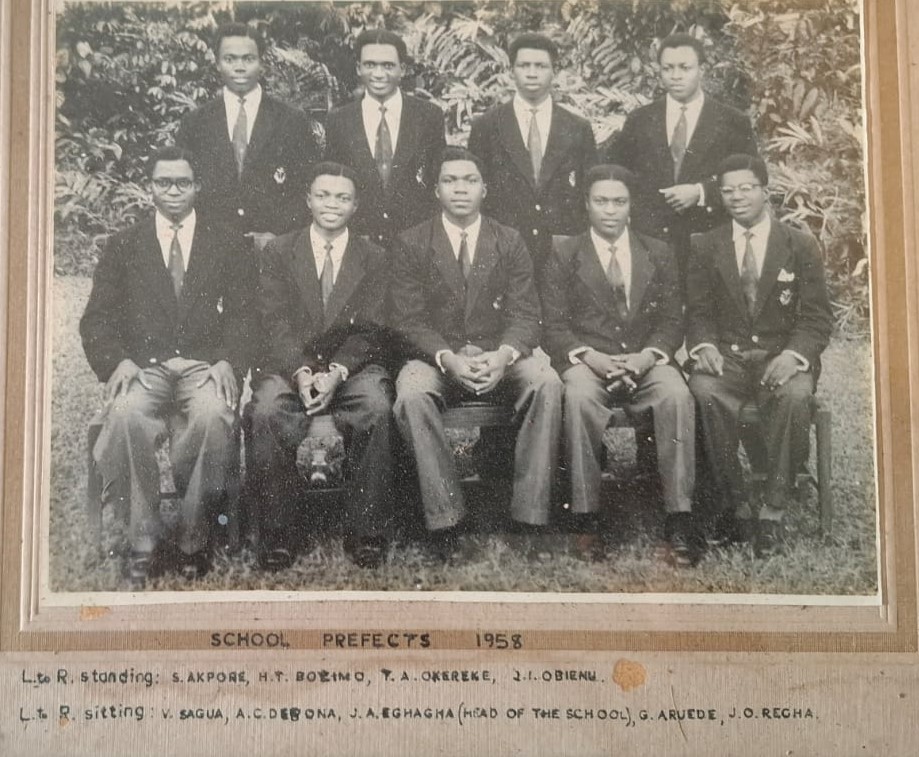
Both Demas and Samson distinguished themselves early at Government College, Ughelli, where they not only excelled in academics but also rose to become Athletic Captains, Cricket Captains, and Soccer Captains of Warri House. That shared legacy of leadership on the field reflected their broader commitment to discipline, teamwork, and excellence—qualities that later defined their adult lives.
While Demas made his mark in politics and education, Samson chose the path of engineering. He trained as an electrical engineer at a time when Nigeria, fresh from independence, was investing heavily in power and infrastructure. His work on national power transmission projects helped strengthen electricity supply and laid the groundwork for future industrial growth. Colleagues remember him as a man of precision, committed to excellence and integrity in every assignment.
Akpore’s early promise became evident at Government College, Ughelli, where he distinguished himself in both academics and athletics. His sprint medals and trophies, later displayed proudly at home, were early signs of a competitive spirit that never dimmed.
A scholarship took him to the Kwame Nkrumah University of Science and Technology in Ghana, where he studied electrical engineering. At a time when opportunities to study abroad were scarce for Nigerians, his achievement marked him out as exceptional.
On returning home in the late 1960s, Akpore joined the Electricity Corporation of Nigeria (ECN), whose imposing edifice stood at Apogbon in Lagos. ECN would later metamorphose into the Power Holding Company of Nigeria (PHCN). He entered at a pivotal moment, as Nigeria sought to expand its electricity infrastructure in the years after independence. His COREN registration number was 870, making him one of the earliest Chartered Engineers of his era. That number was more than a credential; it was a marker of how he stood at the frontier of Nigeria’s engineering profession, part of the generation that carried the young nation’s ambition on their shoulders.
By the 1970s, NEPA sponsored him for advanced studies in Canada, the United States, Germany, and the Netherlands. Those experiences equipped him to take on leadership roles in Nigeria’s transmission projects, where he became integral to laying the groundwork for the country’s power supply network. In 1985, he received a professional award recognizing his contributions before his transfer to Lagos—an honor regarded as rare within the authority.
While his engineering career soared, Akpore remained deeply tied to sports. He had excelled in athletics as a young man, sprinting his way to school championships. Later, he turned his attention to cricket, where his talents won him a place in the Nigerian national team.
Balancing a professional life in NEPA with international cricket duty was no small feat. Yet Akpore managed it, and his dual reputation as both an engineer and athlete earned him admiration from colleagues who often spoke of his unique combination of brains and brawn.
On July 15, 1967, Akpore married Helen Osatohawen Evbuoma at Regina Mundi Catholic Church in Mushin, Lagos. The wedding was so widely attended that the church grounds could barely contain the crowd. Together, they raised six children: Samson Onoriode Akpore Jr – Nigeria
Henrietta Udumebrai Akpore (deceased), Andrew Oghenekobaro Akpore – UAE, Francis Okiemute Akpore – Nigeria, Lawrence Ogheneochuko Akpore – USA/Switzerland, Priscilla Eseoghene Oluwashina – United Kingdom
Akpore’s home was known as a place of welcome. He was deeply community-minded, often turning his compound into a gathering space for neighbors. Friends recall his artistic side—whether acting in plays, mimicking disc jockeys, or singing for amusement—as evidence of a personality that drew people in.
After retiring from NEPA in 1991, Akpore remained a respected presence until his passing in 1999. On November 5 of that year, the Vanguard newspaper published a tribute that captured his stature as both engineer and sportsman.
Those who knew him speak of his determination, his generosity, and his sense of discipline. His distinctive slanting hairline once became a trend in schools and cricket circles, a small but telling example of the influence he carried. As a father, he ensured his children pursued education above all else, even when his professional postings meant personal sacrifice.
Two and a half decades after his passing, Engr. Samson A. Akpore remains remembered as more than an engineer or athlete. He was a trendsetter, a motivator, and above all, a man whose life illustrated how talent and service could coexist to shape community and country alike. His journey as one of Nigeria’s earliest Chartered Engineers placed him within the larger story of nation-building, where individual excellence fused with national progress. To remember him is to remember a chapter of Nigeria’s early drive for power, pride, and possibility.