
By Foster Akpore
PORT HARCOURT, Rivers State – The Nigeria Security and Civil Defence Corps (NSCDC), Rivers State Command, has partnered with the Male Feminist Network (MFN) South-South Nigeria to strengthen efforts towards gender equality, positive masculinity, and the prevention of Gender-Based Violence (GBV) through a one-day sensitisation and capacity-building programme for officers of the Command.
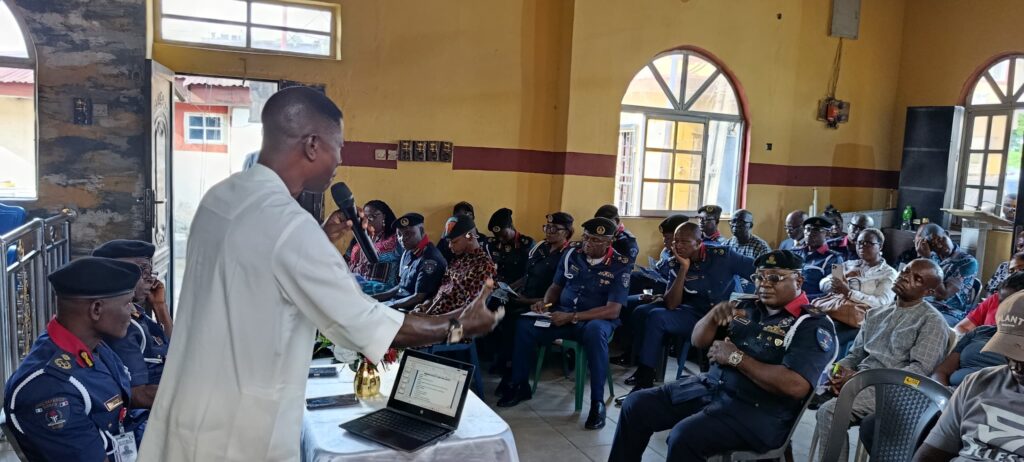
The training, held on Friday, 24 July 2026, at the NSCDC Rivers State Command Headquarters in Port Harcourt, focused on male feminism, gender justice, positive masculinity, and the implementation of the Violence Against Persons (Prohibition) Act (VAPP Act).
Facilitated by the South-South Zonal Coordinator of the Male Feminist Network, Pastor Edewor Egedegbe, the programme sought to equip NSCDC personnel with the knowledge and skills required to prevent and effectively respond to cases of Gender-Based Violence in their communities.
Speaking at the opening of the programme, Pastor Egedegbe commended the Rivers State Command for partnering with the Male Feminist Network to advance gender equality and promote safer communities. He described the collaboration as a strategic step in strengthening the capacity of security personnel to address issues affecting vulnerable groups.
He noted that the engagement builds on similar successful trainings previously conducted for officers of the Nigeria Police Force Zone 16, underscoring the growing commitment of security institutions to mainstream gender-responsive approaches in their operations.
During his presentation, Pastor Egedegbe explained that feminism advocates equal rights, opportunities, dignity, and treatment for both women and men. He challenged widespread misconceptions that feminism is anti-men or intended to undermine family values, stating that its core principles are rooted in justice, mutual respect, and equal opportunities for all members of society.
The facilitator further highlighted the distinction between healthy and toxic masculinity, urging participants to embrace positive masculinity by using their influence and strength to protect, support, and advocate for justice and non-violence.
He also clarified the concepts of sex and gender, noting that while sex refers to biological differences between males and females, gender encompasses socially and culturally assigned roles and expectations. He called on participants to challenge harmful stereotypes that restrict women’s participation in leadership, education, employment, and decision-making processes.
Drawing from community-based advocacy experiences, Pastor Egedegbe cited examples where inclusive approaches had significantly increased women’s participation in community leadership and governance, adding that societies thrive when both men and women are empowered to contribute meaningfully to development.
Addressing Gender-Based Violence, he described it as any harmful act committed against an individual because of their gender. He identified its various forms, including physical, sexual, emotional, psychological, and economic violence, stressing that economic abuse—such as denying women access to employment opportunities or financial resources—is recognised and punishable under Nigerian law.
He also provided an overview of the Violence Against Persons (Prohibition) Act, explaining that the legislation is designed to prevent violence, protect survivors, prosecute offenders, and strengthen community responsibility in safeguarding vulnerable persons.
Pastor Egedegbe reminded participants that the law protects all persons irrespective of gender, including women, men, children, and persons living with disabilities. He urged officers of the NSCDC to treat domestic violence and other forms of Gender-Based Violence as criminal offences rather than private family matters.
According to him, effective responses to GBV require the protection of survivors, proper evidence gathering, and diligent prosecution of perpetrators.
He emphasised that preventing violence is a collective responsibility involving families, traditional institutions, religious leaders, security agencies, civil society organisations, and citizens. He called on men and boys to become active allies in promoting gender equality by speaking out against violence, supporting girls’ education, and fostering healthy and respectful relationships.
The programme featured an interactive question-and-answer session during which participants sought clarification on survivor support mechanisms, the availability of safe shelters, and the responsibilities of relevant government institutions. Responding to the concerns raised, Pastor Egedegbe explained that state Ministries of Women Affairs and Social Welfare play primary roles in providing shelter and psychosocial support services for survivors, while civil society organisations complement government efforts through advocacy, referrals, and community engagement.
The Gender Desk Officer of the NSCDC Rivers State Command observed that men are also victims of Gender-Based Violence but often remain silent because of societal expectations. She encouraged male survivors to seek help and report incidents of abuse whenever they occur.
In his closing remarks, Pastor Egedegbe urged participants to become ambassadors of positive masculinity by sharing the knowledge gained during the training within their workplaces, families, and communities. He encouraged them to reject all forms of violence, promote fairness and inclusion, and support women’s participation in leadership and decision-making processes.
The programme concluded with the inauguration of the Male Feminist Network Rivers State Steering Committee, presentation of certificates to participants, a group photograph, and a networking session.
The training forms part of the Male Feminist Network’s ongoing South-South advocacy campaign aimed at mobilising men and boys as partners in advancing gender equality, preventing Gender-Based Violence, and building peaceful and inclusive communities across Nigeria.