
By Foster Akpore
At the Delta State conference, speakers stress skills development, integrity, mentorship and innovation as keys to career advancement and community impact.
Young professionals have been challenged to take responsibility for their personal development, acquire relevant skills and translate their aspirations into practical contributions to society at the 2026 KAIROS conference of the Young Professionals Forum (YPF), Delta State.
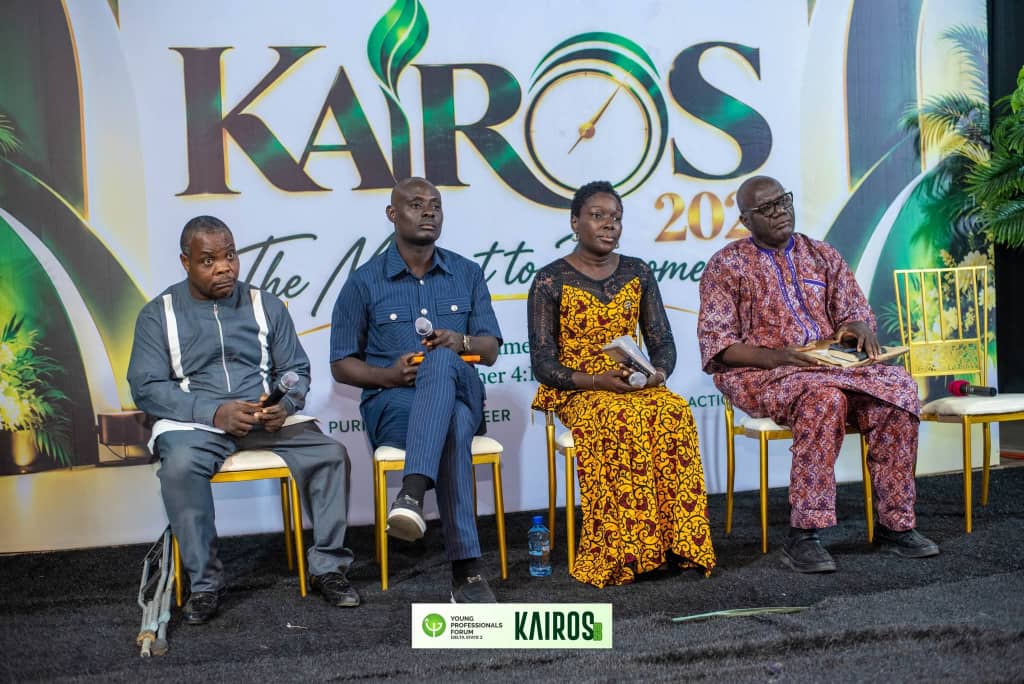
The conference, held on Saturday, November 7, at Wellington Hotel, Effurun, Delta State, had as its theme, The Moment to Become.
Speakers at the event emphasised that opportunities must be matched with preparation, urging participants to develop the competence, discipline and character required to succeed in their chosen fields.
The programme brought together church leaders, professionals, entrepreneurs, invited guests and young people for discussions on spiritual growth, career development, entrepreneurship, leadership and personal responsibility.
In his welcome address, Engr. Wale Ajao described Kairos as an appointed or decisive moment when purpose and opportunity converge. He urged participants to recognise the opportunities before them and take deliberate steps towards fulfilling their potential.
He warned against depending on others to create progress, using the illustration of a wheelbarrow that remains stationary until someone pushes it.
“Don’t live your life to chance, lest you stand no chance,” he said, stressing that personal transformation requires intentional preparation and action.
Ajao added that destiny was shaped by purpose, excellence built through discipline and impact created through action.
Introducing the KAIROS vision, Dr. Edirin Otegbale explained that the Young Professionals Forum was established to help young people sustain their spiritual and personal development as they move from the campus environment into wider adult responsibilities.
He presented KAIROS as an acronym for six principles: Keep Growing with Intent, Alignment, Invest, Rise to Responsibility, Open Conversation and Step into Action.
Otegbale challenged participants to consider whether they had the capacity to handle the opportunities for which they prayed.
“If God opened the door you are praying for, do you have the capacity?” he asked.
He urged young professionals to invest in themselves, identify problems they could solve and accept responsibility in their workplaces, churches and communities.
In the spiritual development session, Rev. Kesiena Esiri urged participants to discover their God-given purpose and allow it to guide their personal and professional decisions.
He emphasised that Christian responsibility extended beyond formal church activities to include conduct in the workplace and wider society.
“Your workplace is your pulpit,” Esiri said, calling on participants to demonstrate integrity, diligence and responsible conduct in their professional lives.
He also stressed the importance of understanding divine timing, spiritual maturity and the responsible use of personal abilities and resources.
Addressing career development, IT specialist Gideon Ogbonna identified early preparation, continuous learning, excellence in small assignments and problem-solving as essential to building a meaningful career.
Speaking on the topic, Building a Career That Matters: Positioning Yourself for Growth and Impact, Ogbonna advised young people not to wait until they secured paid employment before developing their skills.
He illustrated the point with the story of Dr. Ben Carson, whose mother’s emphasis on reading and discipline helped shape his academic and professional journey.
Ogbonna, who works in the technology sector, also shared his experience with the development of an enterprise resource planning system at Tantita Security Services. He said professional preparation had positioned him to contribute to the company’s effort to develop an internal solution to its operational needs.
He encouraged participants to embrace technology, including artificial intelligence tools, and identify areas of specialisation.
He also argued that problems could provide opportunities for innovation, citing a proposed technology solution to help elderly people and persons with disabilities operate smartphones through voice commands and local languages.
“Your big moment will look like a problem,” he said, urging participants to combine technical competence with collaboration.
In the business and skills development session, Mrs. Charity Edefughe, National Youth Coordinator, Entrepreneur, Warri Chambers of Commerce Industry Mines and Agriculture, Delta State, said economic opportunities emerged when people developed their abilities and applied them to solve problems.
“Nobody pays you for what you know. People pay you for the value you create with what you know,” she said.
Edefughe outlined four steps for turning abilities into opportunities: discovering one’s skills, developing them, creating value by solving problems and making the resulting work visible to potential customers.
She cautioned participants against copying business ideas without understanding their markets, stressing the importance of location, customer needs and demographics.
She also encouraged young entrepreneurs to use professional networks, social media and business events to showcase their products and services.
The leadership development session, delivered by Mr. Oviruo A. Ogheneruemu, examined the challenges and opportunities confronting young professionals.
Ogheneruemu identified unemployment, underemployment, inadequate digital competence, lack of practical experience, limited mentorship, financial difficulties and fear of failure among the major challenges facing young people.
He listed digital skills, work etiquette, problem-solving, time management and teamwork as essential employability skills.
For aspiring entrepreneurs, he highlighted creativity, opportunity identification, marketing, sales, financial management, negotiation and networking.
He encouraged participants to seek practical experience through internships, volunteering and professional associations, adding that small opportunities could provide a platform for greater responsibilities.
Using the Nigerian recycling enterprise Wecyclers as a case study, he demonstrated how innovation could turn an environmental problem into an economic opportunity.
The conference also featured a panel discussion during which participants sought advice on mentorship, business financing, career choices, volunteering, employment and entrepreneurship.
Questions were raised about accessing grants and soft loans, developing professional networks, securing practical experience and turning academic projects into viable solutions.
One participant presented a final-year intelligent waste-management project and sought guidance on taking it beyond the academic environment into practical implementation.
The panellists advised participants to build professional relationships, maintain proper business records, understand funding requirements and begin business ventures on a manageable scale.
They also encouraged students to prepare for their careers before graduation and to approach experienced professionals for mentorship.
The KAIROS Action Session, led by Engr. Innocent Isichei Utebor, challenged participants to connect the lessons of the conference with spiritual empowerment and deliberate action.
Drawing from John 1:12 and the biblical account of Elijah and Elisha in 2 Kings 2, Utebor urged young professionals to recognise their defining moments and prepare for greater responsibilities.
He used the journey from Gilgal through Bethel and Jericho to Jordan to illustrate progression, spiritual encounters and the need to confront obstacles.
“Preparation is an acceleration for your manifestation,” he said.
In the closing charge, the State Patron of YPF Delta State, Pst. Napoleon Owhuvwie, presented what he described as the process of becoming, from the promise to the product.
He outlined ten stages: promise, purpose, perception, passion, prayer, the path into the impossible, the prevailing power of God’s Word, planning, practice and the final product.
Owhuvwie urged participants not to allow the inspiration of the conference to fade after the event, but to develop practical plans and consistently apply what they had learnt.
He emphasised that purpose, faith and passion must be accompanied by discipline and action.
In his vote of thanks, the YPF State President, Samuel Ukaegbu, expressed appreciation to God, the spiritual leaders, speakers, sponsors, partners, organisers, volunteers and participants for their contributions to the success of the conference.
He said the organisers expected the lessons from KAIROS ’26 to produce visible results in the spiritual lives, careers, businesses, leadership responsibilities and communities of participants.
Ukaegbu also announced that the Delta State chapter would soon commence a Young Adult Church initiative, following an instruction from the church’s spiritual leadership. He called on members to support the proposed initiative.
The conference ended with a call for young professionals to move from inspiration to responsibility and from personal development to meaningful service.
Its central message was that recognising one’s moment must lead to discovering one’s assignment, developing the capacity to fulfil it and taking action.