
By Wilson Egbodje
“The greatest questions of the day will not be resolved by speeches and majority decisions—that was the mistake of 1848 and 1849—but by iron and blood.”
— Otto von Bismarck, 1862, first Chancellor of Germany and architect of the first unification of Germany in 1871.
“In view of the threats to our freedom and peace on our continent, the rule for our defence now has to be ‘whatever it takes.’ Germany is making its major contribution to defending peace and freedom in Europe… Germany is back.”
— Friedrich Merz, March 18, 2025, incoming Chancellor of Germany.
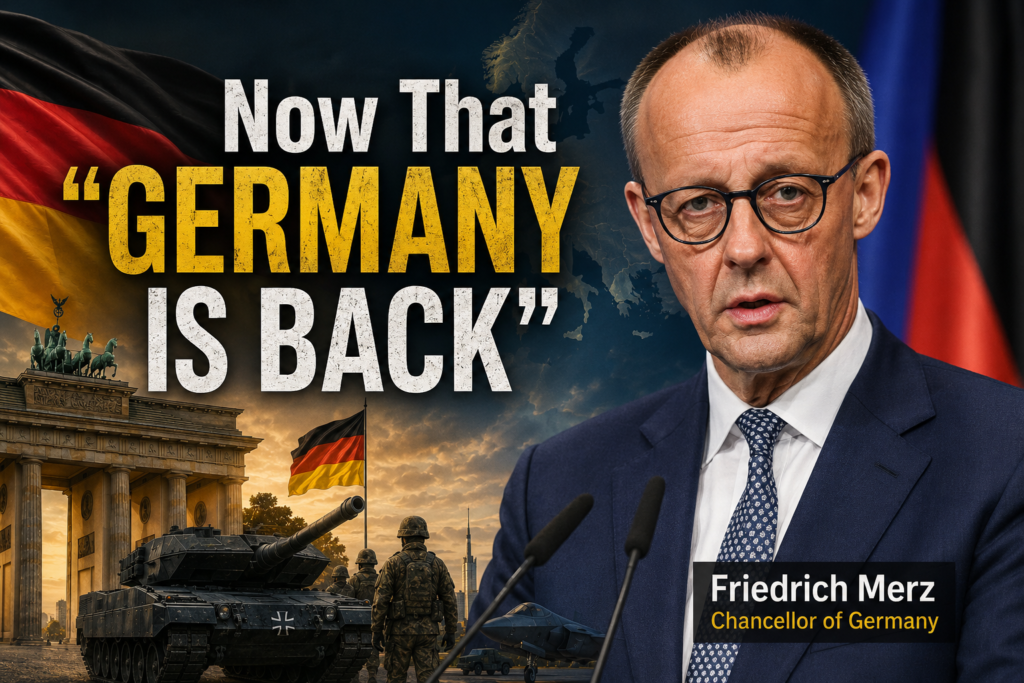
The statement, “Germany is back,” reflected above, literally suggests a return to what was once considered a phenomenal past existence. Given its many possible interpretations, only the statements preceding the phrase provide a clue to its multifaceted implications. For those who know better—and those who may be concerned—the phrase can be spine-chilling.
The question is: Where is Germany returning to, and for what purpose?
In very clear terms, Germany is returning to militarism to ensure not only its own security but also the security of Europe.
Germany’s leaders are not known to mince words. Their methods may be Byzantine and, at times, unwholesome, but they jealously guard the fundamental principles of cohesion applied by Bismarck and Emperor William of Prussia, who united disparate Germanic nation-states and fiefdoms to achieve their overall goal in 1871.
Bismarck’s speech quoted above was an address to Parliament seeking the release of funds to build a strong army for the Prussian Empire. It remains the ultimate symbolic expression of how far Germans can go to achieve desired objectives.
No period in German history inspires Germans more than the era that witnessed the translation of Bismarck’s policy of “iron and blood” into reality. It marked the beginning of German militarism and military expansion. In essence, all of Europe was terrified and felt compelled to accommodate Germany’s professed aspirations. The arms buildup continued and eventually culminated in the outbreak of World War I (1914–1918).
Should Adolf Hitler be left out of this discussion? Perhaps. His drive may simply be viewed as part of a continuum—a complicated project rooted in the past. More profoundly, it sought to assemble the remnants of Germanic peoples still under the rule of non-German governments. It appeared to be a continuation of Bismarck’s unfinished endeavors. Hence came the annexation of Austria, the invasion of Poland, and later a full-scale war against much of Europe.
However, his rabid desire to establish an “Aryan Race” destined to rule the world introduced deeply disturbing dimensions. Hitlerism, or Nazism, remains one of the most studied and troubling episodes in human history, characterized by Hitler’s bizarre declarations and the rise and eventual downfall of the Third Reich.
Interestingly, Friedrich Merz’s March 18, 2025, declaration that “Germany is back” was delivered to the same German Parliament—the Bundestag—addressed by Bismarck over a century earlier. Merz made a fervent appeal to Germany’s budget planners to reverse restrictions on debt ceilings. The objective was to free up resources for investments aimed at strengthening Germany’s military-industrial complex, enabling it to play a leading role in addressing Europe’s defence and security challenges.
It is important to note that Merz’s vision was not limited to Germany alone but extended to Europe as a whole, including the United Kingdom. Consequently, it came as no surprise when the Bundeswehr, Germany’s armed forces, received the green light for a substantial increase in defence spending. Shortly afterward, a staggering €100 billion was made available. This underscored the latent anxiety that had remained bottled up within German political circles for decades.
In the week that followed, the Bundeswehr announced the immediate deployment of 5,000 troops to Lithuania. This marked the first permanent deployment of German troops outside German territory in 80 years since the end of World War II.
For Germany’s strategic hawks, it was a triumphant re-entry into a new era. Lithuania, along with its Baltic neighbors Estonia and Latvia, shares borders with Belarus, where Russian troops are also stationed. At the inauguration of the brigade in Vilnius on May 22, 2025, Merz declared:
“The security of our Baltic allies is also our security.”
Germany now possesses a strategic tripwire force in the Baltic region, albeit still under NATO command.
The significance of this deployment is threefold.
First, it would facilitate the rapid deployment of troops to Estonia and Latvia should they come under attack.
Second, it would enable the deployment of German military assets, such as the Taurus KEPD 350 long-range air-launched cruise missile system and advanced air defence platforms, closer to Russian territory when required.
Third, it would serve as a deterrent and rapid-response force against any preemptive strike along Europe’s eastern flank.
It is also noteworthy that, absent the restrictions imposed after World War II, Germany possesses an economy strong enough to sustain another arms race and station troops across the globe.
Germany is currently the world’s third-largest economy, with an annual Gross Domestic Product (GDP) of nearly $5 trillion, surpassed only by the United States ($27.7 trillion) and China ($17.8 trillion). The United Kingdom stands at approximately $3.4 trillion, Russia at $2.6 trillion, and France at $2.18 trillion.
Three weeks before Merz’s address to the Bundestag, President Donald Trump’s inner-circle MAGA emissaries traveled to Europe to brief political and military leaders on America’s emerging strategic outlook and the realities of a changing world order.
To the surprise of many European leaders, Vice President J.D. Vance criticized Europe for what he perceived as inadequate adaptation to contemporary political and cultural realities. Defence Secretary Pete Hegseth warned that American security guarantees for Europe could no longer be taken for granted.
Indeed, some figures within Trump’s circle have advocated withdrawing U.S. troops from Europe and even reconsidering America’s membership in NATO.
Europe, therefore, must increasingly take responsibility for its own defence.
Germany’s top military officer, General Carsten Breuer, had sounded the alarm months earlier:
“We are threatened by Russia. We are threatened by Putin. We have to do whatever is needed to deter that… Russian aggression won’t stop at Ukraine. It is not about how much time I need. It is about how much time Putin gives us to be prepared. NATO should be prepared in as little as four years.”
This represents one of the most consequential shifts in German strategic thinking since the country’s unification in 1871.
A Russian ally of President Vladimir Putin once remarked that “it is part of Russia’s policy that Germany would be removed from the face of the earth” should signs of unrestrained militarism re-emerge there.
Indeed, Donald Trump’s return as the 47th President of the United States has generated concern over the disruption of international norms that have underpinned the post-1945 rules-based global order. These developments pose serious questions for global stability and merit close attention.
Germany has lived under the shadow of 1945 for decades. Post-war restrictions imposed by the victorious Allied powers drastically limited the size and capabilities of its armed forces. Production of chemical, biological, and nuclear weapons was prohibited.
At the height of Nazi Germany, the Wehrmacht numbered over four million personnel, a force powerful enough to destabilize Europe and beyond.
Germany has since enjoyed eighty years of economic growth while committing relatively modest resources to defence. Since reunification, it has generally maintained defence spending at around 2 percent of GDP while relying heavily on NATO and American military protection.
Today, however, Germany is economically equipped to assume a leading role in European security. In that regard, Donald Trump’s insistence that Europe shoulder greater responsibility for its own defence appears increasingly justified.
Of the approximately 74,000 U.S. troops stationed in Europe under NATO command, about 34,000 are based in Germany, with major headquarters located in Stuttgart.
Should those forces be withdrawn, Germany’s military would face significant challenges. Nevertheless, a complete U.S. withdrawal remains highly unlikely given the war in Ukraine and America’s longstanding commitment to NATO.
Such a withdrawal would leave Germany and much of Europe facing profound strategic uncertainty.
Now that Germany is back, the world must prepare for the reality of renewed German military power within an emerging multipolar order.
The circumstances, however, are vastly different from those that existed before World Wars I and II.
Today, Europe enjoys a level of political cohesion unimaginable in earlier eras through the framework of the European Union (EU). This unity was evident when British Prime Minister Keir Starmer announced the formation of a “Coalition of the Willing” to support Ukraine following President Volodymyr Zelenskyy’s public dispute with President Trump at the White House in February 2025.
Writing in Newsweek on June 18, 1990, under the title “A Security Plan for Europe,” Dr. Henry Kissinger observed:
“European unity is rapidly advancing in the political field and will sooner or later encompass defence…. At present military issues are discussed within NATO; political issues will find a focal point in the European Community as Europe moves towards unity.”
It was an idea whose time has indeed come.
The European Union has transformed Europe into an increasingly interdependent community of nations. The old rival alliances that once divided Europe into hostile military blocs have largely disappeared.
The geopolitical landscape that produced the 1907 Triple Entente between Britain, France, and Russia against Germany vanished with the end of World War II.
With national borders now firmly established and the lessons of two catastrophic world wars firmly embedded in collective memory, Germany is arguably well positioned to play a leading role in Europe’s security architecture.
Such a development would also relieve the United States as it shifts its strategic focus toward the Indo-Pacific.
China’s rise as an economic and military power has created a new strategic challenge for Washington. During the Cold War, Western defence priorities centered on containing the Soviet Union and the Warsaw Pact. Today, the United States faces a far more complex global environment characterized by shifting alignments and multiple centers of power.
It is therefore welcome news that Germany, the world’s third-largest economy, appears willing to assume a greater military role in this evolving global order.
Equally significant is the fact that Germany stands within a rejuvenated Europe of more than 500 million people and a combined GDP exceeding $20 trillion. Across the continent, governments are committing to increased defence spending and military modernization.
Collectively, these resources should provide a substantial deterrent against aggression from Russia or any other potential adversary.
Russia is perhaps the nation most likely to be unsettled by a resurgent Germany.
The old rivalry may re-emerge, though under very different circumstances. Germany is now a reunified nation, economically powerful and politically integrated into a broader European framework. Eighty years of restraint have not diminished its capacity for scientific innovation.
As Germany returns to the global stage, the world may witness the emergence of advanced military technologies and defence systems built upon decades of research and development.
Yet, in the absence of an independent nuclear arsenal, Germany will continue to rely on NATO—and especially the United States—for strategic protection in the near term.
Only through sustained investments in advanced technologies and defence capabilities can Germany fully establish itself as a formidable military power capable of helping secure both Europe and the broader NATO alliance in the decades ahead.